
What is Soil PH and why does it matter?
Soil pH is a measure of the concentration of hydrogen ions in the soil, reflected on a scale from 0 to 14, where 0 represents the most acidic and 14 the most alkaline (also known as basic). The majority of soils fall within the range of 3 to 10, with the extremes at either end considered detrimental for plant growth.
The crucial significance of soil pH stems from its impact on the availability of specific nutrients and the subsequent effects, both detrimental and beneficial, on plant health and growth. At extremes of PH, certain nutrients such as aluminum and manganese are available (meaning soluble and actively, unavoidably uptaken) at levels toxic to plant health, contrastingly, essential nutrients such as nitrogen and calcium will be become less available. At an optimal soil pH, the availability of essential nutrients like nitrogen, phosphorus, and potassium is maximised.
Soil pH also affects water availability in the soil. Highly alkaline soils, typical of arid conditions, lack water-holding capacity and permeability, making them particularly susceptible to the effects of drought. Conversely, highly acidic soils found in high-rainfall areas feature good drainage and water-holding ability, though the benefits can be countered by aluminum toxicity. Under both extremes of alkalinity and acidity, microbial activity is diminished, and many beneficial organisms, including earthworms, may disappear.
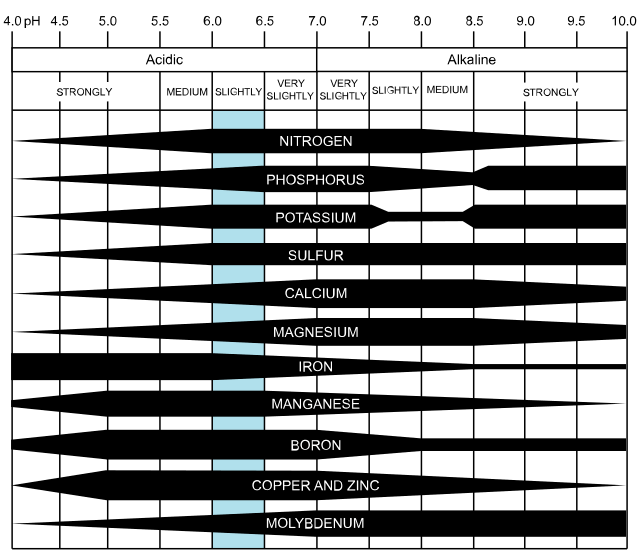
Fe-Iron, Mn-Manganese, Ca-Calcium, Mg-Magnesium, Mo-Molybdenum, Cu-Copper, Zn-Zinc, N-Nitrogen, S-Sulfur, P-Phosphorus, B-Boron, K-Potassium
What is a good soil PH?
There is no perfect pH for cultivating fruit trees, as they have evolved to thrive in various conditions, spanning alkaline, acidic, and neutral soils. This diversity results in different preferences, making it challenging to pinpoint a universally ideal soil pH for all plants. Generally, a slightly acidic to neutral pH ranging between 5.5-7.5 is often considered optimal for cultivation. This range maximizes the availability of essential nutrients like nitrogen, phosphorus, and potassium (NPK) while minimizing the presence of potentially toxic elements.
For fruit tree cultivation, a slightly acidic pH of 5.5-6.5 may be more advisable, as many fruit trees tend to benefit from a slightly acidic soil, compared to slightly alkaline soils where fewer trees thrive, such as Olive, Sapodilla, and Dates. It’s crucial to recognize that gardens with highly acidic or alkaline soils can pose challenges and may require more excessive amendment than gardeners are prepared for. In such cases, container growing emerges as a viable solution to create a more controlled and favorable environment for fruit trees.
Refer to the following page for some suggestions on plants suitable for acidic soils – Acidic Soil Lovers
How can I amend my soil to adjust its pH?
There are various products available for gardeners to adjust the pH of their soil, each with varying speeds of effectiveness, strength of impact, nutritional composition, and influence on soil structure. The following provides a detailed overview:
High PH – Alkaline
- Dolomite Lime: A natural solution with a relatively slow release. Excellent source of magnesium and calcium, which are constituent components of Dolomite. Avoid applying to soils with high magnesium levels, as excess magnesium may be toxic.
- Garden Lime/Agricultural Lime: Provides a more rapid, short-term fix but not a longer-term solution. Offers significant amounts of calcium like Dolomite, but by comparison has a faster effect without additional magnesium.
- Wood Ash: An organic option for increasing soil pH in acidic soils (Wood Ash pH is between 10-12). A free byproduct after any woodfire, rich in calcium, potassium, with moderate amounts of magnesium, and phosphorus.
- Animal Manure: Generally raises soil pH, especially poultry manure, due to calcium and magnesium. An excellent soil conditioner and general fertilizer, ideal for long-term, consistent usage with multiple benefits.
Low PH – Acid
- Elemental Sulphur: Simple, cost-effective method to lower Soil PH and add sulfur, an essential plant nutrient for growth and development. Available in granular, powder, or liquid form.
Neutral/Mixed PH Impact
- Compost: Excellent organic method for pH improvement through long-term, regular applications. Typically has a pH between 6-8, ideal for many plants although potentially too alkaline for some but very easily offset. Enhances soil structure and provides key and micronutrients, key garden supplement.
- Mulch: Impact on soil pH varies depending on the type of mulch, although generally most mulches have a negligible impact on soil pH, especially in the short term and given they are limited to the topsoil. Pine bark and pine needle mulches have an acidifying effect, while hardwood mulches may raise soil pH. Excellent at retaining soil moisture and improving soil structure in the long term. Should be used by all gardeners regardless.
- Gypsum: Has no effect on soil pH, therefore perfect for use when content with Soil PH. Aids in reclaiming saline soils, adds calcium and sulfur, reduces aluminum and boron toxicity, and has a clay-breaking effect.
 Hortiforum