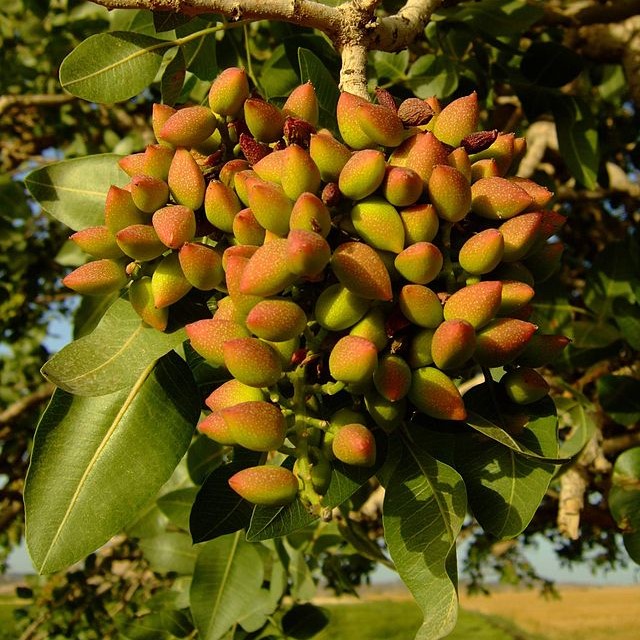
Perfectly suited to cold, semi-arid climates, the Pistachio offers a low-maintenance, water-wise option for gardens in climates typically reliant on irrigation. For millennia, Pistachio fruits have graced Western and Central Asian cuisines, but are now celebrated globally for their easily shelled nuts and delicious flavour. Botanically classified as a drupe, similar to Peaches, Mangoes or Avocado, Pistachios often naturally split open once they’re ripe. Whether enjoyed as a roasted snack or incorporated into desserts like ice cream, Pistachios lend themselves to a diverse array of culinary applications. Pistachios can be used in Baklava, incorporated into Turkish Delight, or as a crunchy garnish atop savoury rice dishes like Pilau. Native to the cold, semi-arid deserts of Central and West Asia, Pistachios thrive in climates characterized by cold, brisk winters boasting over 1000 chill hours, and scorching, arid summers essential for proper flowering and fruiting. While tolerant of soil salinity, Pistachios do not fare well in coastal climates due to the mitigating effects on temperature, which hinder the distinct temperature fluctuations necessary for optimal production. Ideally suited for water-wise, arid gardens, Pistachio trees require minimal irrigation in semi-arid climates to encourage prolific flowering and fruiting. Pistachios tolerate dry, calcareous soils with a relatively high pH up to 8.5, typically necessitating no soil adjustments. A full sun position is crucial and a well-draining, sandy loam soil is ideal. Pistachio may crop biannually, yielding bountiful harvests every second year. Pistachio are dioecious, with plants being either male or female and requiring cross-pollination in order to set fruit, one single male plant may be capable of fertilising up to 15 female plants. Pistachio trees are dioecious, meaning they are either male or female, and require cross-pollination to produce fruit. Remarkably, a single male plant has the potential to fertilise up to 15 female plants. Adorned with dense clusters of dark red flowers that give way to small, reddish-tinged fruits, the Pistachio tree presents an enchanting spectacle during both flowering and fruiting seasons. Although Pistachio trees can reach heights of up to 10 metres, they can be pruned to a more manageable size below 3 metres to facilitate harvesting and maintenance. Pistachio trees boast deciduous foliage composed of pinnate gray-green leaves, forming a low-spreading canopy. Embrace the climatic rigours of arid regions and savour the satisfaction of cultivating your own delectable, homegrown Pistachios.
All Varieties are grafted unless noted. Please reach out to us (Contact & Socials) if you come across any broken links, incorrect details, or if you represent an online nursery that sells the products mentioned above.

 Hortiforum