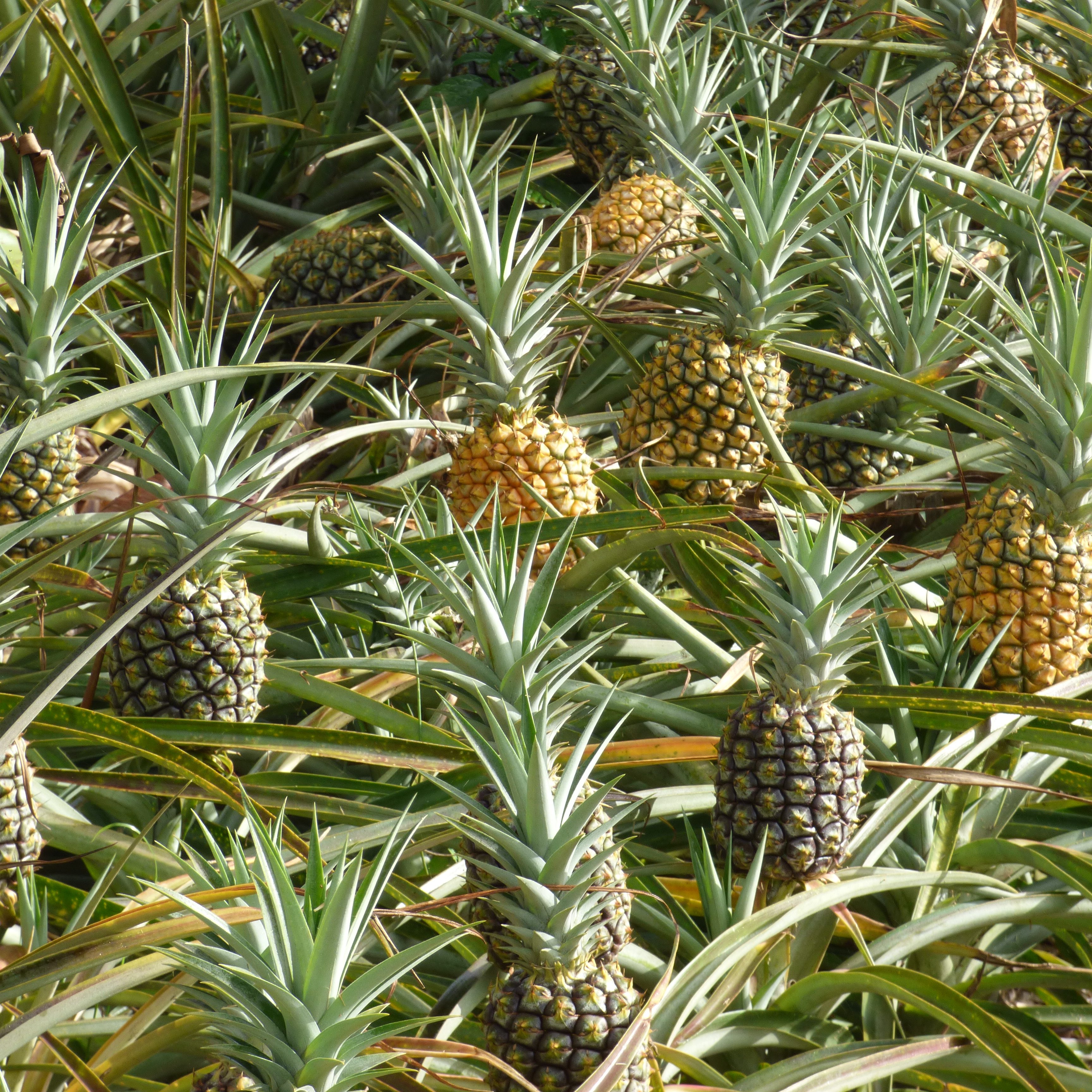
The Pineapple, a resilient and adaptable fruiting plant, thrives with minimal care relative to the delectable fruit it yields. Renowned for their succulent, sweet, aromatic flesh, Pineapples require little promotion as one of the most popular tropical fruits. Whether consumed fresh, chilled, juiced, canned, or incorporated into various dishes and desserts, Pineapple have a vast multitude of culinary uses. Pineapple adds a delightful touch to savoury dishes like hamburgers, pizzas, fried rice, and curries. Equally versatile in sweet creations, it is perfect in cakes, cocktails, fruit salads, preserves, and jellies with its unique flavour. Pineapples are members of the diverse Bromeliad family and form low-lying (up to 1.25m), herbaceous, perennial plants. They boast a central stem from which sword-shaped, rigid leaves radiate. With their spiny edges, these dull green leaves can serve as a natural deterrent, hindering passage through an area at ground level. Pineapples, akin to their fellow herbaceous plant, the Banana, produce only one inflorescence over their lifetime. This inflorescence, often strikingly red in many varieties, contains hundreds of individual flowers. As these flowers mature, they merge to form what botanists refer to as a ‘multiple fruit.’ Pineapples can be propagated either by planting the crown of the fruit (provided the spiky leafy top has not been discarded) or through suckers, commonly known as pups or slips. Both methods are straightforward, involving either direct planting into a well-watered soil or initially placing them in water to encourage root development. Thanks to their compact size and modest profile, Pineapples thrive in confined spaces where larger plants might struggle, making them ideal for filling narrow gaps along walls, small garden beds, or tight, uncultivated spaces between other plants. Their undemanding and resilient nature, coupled with their shallow root system, also makes Pineapples excellent candidates for container cultivation. Pineapple can be cultivated under the canopy of other plants without too much competition, thanks to their modest water requirements, shallow roots and tolerance of partial shade. Pineapple plants yield throughout the year in tropical and subtropical climates but demand a frost-free environment. While Pineapples exhibit high drought tolerance, they thrive in regions with moderate to high rainfall, adapting well to both monsoonal climates and areas with consistent precipitation. Pineapples can tolerate various soil types, ranging from clay to sand, and from acidic to neutral pH levels, however, they prefer slightly acidic, well-draining soils and thrive in full sun exposure. Pineapples require minimal care post-planting and are an excellent choice for a low-maintenance garden. With its ease of cultivation and undemanding nature, the Pineapple stands out as one of the most delicious fruits for the effort invested.
Please reach out to us (Contact & Socials) if you come across any broken links, incorrect details, or if you represent an online nursery that sells the products mentioned above.


 Hortiforum