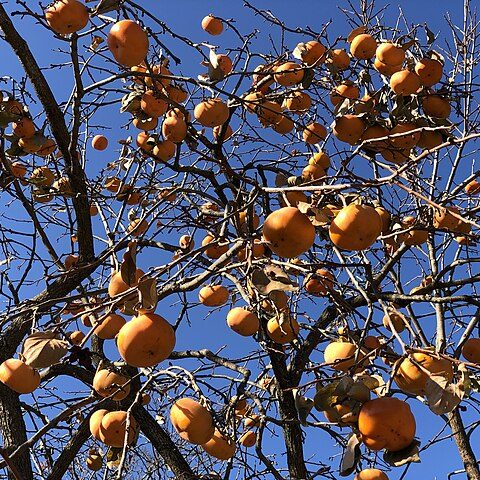
The Divine Fruit, the Persimmon is a luscious treat and one of the latest fruits to ripen in temperate areas, with the harvest of fruits in late autumn. Fruit Persimmon varieties are broadly categorized into Astringent and Non-Astringent types. Astringent varieties retain tannins even when ripe, necessitating a process called bletting, where the fruit is allowed to rest and ripen, akin to Medlar or Black Sapote, resulting in a delightful, jelly-like flesh imbued with a honey-like sweetness. Non-Astringent varieties are gaining popularity due to their ability to be enjoyed fresh off the tree, akin to an Apple, boasting a crispy and crunchy flesh. Non-astringent persimmons can be stored for up to three months in a cool, humid location, or can be dried or preserved for longer-term storage. Persimmons stand as the most renowned fruit of the Diospyros genus within the Ebenaceae family, with the genus name Diospyros translating to ‘Divine Grain’ or ‘Divine Fruit’. Relatives within the genus include Black Sapote and Velvet Apple, the former of which is also highly astringent and necessitates a bletting process. Growing Requirements Persimmons are a generally undemanding tree, tolerating a range of soils and being suitable to a wide climatic range from temperate to subtropical. The few requirements for Persimmon trees are good drainage, full sun, protection from strong winds and moderate watering throughout spring and summer. Persimmon Trees are notably suitable for subtropical climates given their low chill hour requirements, varying between 100-400 hours dependent on variety. Generally, non-astringent varieties have lower chill hour requirements than astringent varieties. Spring is the main growth period for plants and as such is a crucial period. Providing generous mulch, water and fertiliser throughout this period and early summer will set up Persimmon trees for a prolific harvest later in Autumn. Owing to their tendency to fruit prolifically, Persimmon trees can often be overladen with fruits. Given this, it is often recommended to thin fruits for several reasons. Firstly, to prevent branch damage; secondly, to enhance fruit size; and thirdly, to prevent tree exhaustion, thus averting the risk of biennial bearing, where trees produce either no or limited crops in the following season. Appearance Trees typically reach an average height ranging from 6 to 9 metres, depending on the specific variety, yet can be effectively maintained at a lower height through active pruning. As autumn arrives, Persimmon leaves undergo a stunning transformation, showcasing fiery hues of dark red to orange before falling and leaving the tree adorned with ripe orange fruits, a captivating natural decoration. However, this exposure can render the fruits vulnerable to birds and other pests, necessitating the use of netting to safeguard the harvest. Notably, Persimmon flowers bloom late in spring, shielding them from potential damage caused by early spring frosts or cold snaps. These flowers emerge on both new growth and one-year-old growth, meaning that Persimmon trees should be pruned at least biannually to ensure there is wood suitable for fruiting. Beautiful, prolific and easily cared for, a Persimmon tree is undeniably excellent value given the abundance of superb fruit it produces.
All Varieties are grafted unless noted. Please reach out to us (Contact & Socials) if you come across any broken links, incorrect details, or if you represent an online nursery that sells the products mentioned above.


 Hortiforum