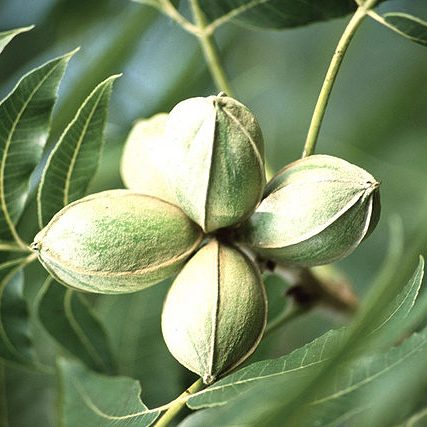
SnickeringBear – CC BY-SA 4.0 – Wikimedia CommonsJerry A. Payne, USDA Agricultural Research Service – CC BY 3.0 – Wikimedia Commons
General Info – Pecan
An ideal addition to the subtropical or warm temperate backyard, the Pecan tree stands out as a relatively hassle-free producer of beloved, delectable nuts. Renowned for their unique buttery, nutty, and rich flavour profile, Pecans are among the most delightful nuts. Their natural sweetness makes them perfect for desserts, such as the iconic pecan pie, caramelised in Praline candies or simply enjoyed on their own either fresh or roasted. In addition to their superb flavour, Pecan nuts are nutritionally excellent, being rich in Dietary Fibre, Zinc, Phosphorus, Magnesium and the micronutrient Thiamine. With just a single tree, gardeners have the opportunity to transform their backyard into a bountiful source of organic, mouthwatering Pecans. Indigenous to the southern USA and northern Mexico, the Pecan thrives in warm temperate to subtropical climates. Pecan trees are particularly well-suited to subtropical climates as they need only 200-300 chill hours, unlike many temperate nut trees like Chestnut, Hazelnut, and Walnut, which often demand higher chill requirements. However, its deciduous nature allows it to adapt to regions with cool to cold winters, as long as they are followed by warm summers, crucial for fruiting and robust growth. Thriving best along riverbanks, Pecan trees flourish in deep, well-draining, and moist soils, though they exhibit notable tolerance to various soil types, from clay to sand, and pH levels ranging from alkaline to acidic. While self-pollinating Pecan varieties exist, optimal results are achieved when ‘A’ and ‘B’ varieties are grown in close proximity for cross-pollination. In Australia, Pecan trees are relatively resistant to pests, although birds may develop a penchant for the nuts, posing a challenge for growers. Left unchecked, Pecan trees can grow to towering heights, becoming iconic features in landscapes. Trees are best kept pruned to a manageable size and have an upright form that allows them to serve admirably as focal points or sources of shade. Trees are most effectively maintained through regular pruning to ensure they remain at a manageable size. Pecan trees have an upright form that makes them ideal as focal points or shade trees, able to provide summer shade and winter sunlight. The alternate, Olive-green leaves of the Pecan are highly attractive. Pecans are a member of the Juglandaceae family together with Walnut, which similarly produces inconspicuous female flowers and male flowers in catkins. Particularly well-suited to subtropical climates where options for nut trees are limited, once established, a Pecan tree promises generous harvests and minimal maintenance, rewarding owners with abundant yields and few troubles.
All Varieties are grafted unless specified. (A) or (B) refers to pollination type. Please reach out to us (Contact & Socials) if you come across any broken links, incorrect details, or if you represent an online nursery that sells the products mentioned above.


 Hortiforum