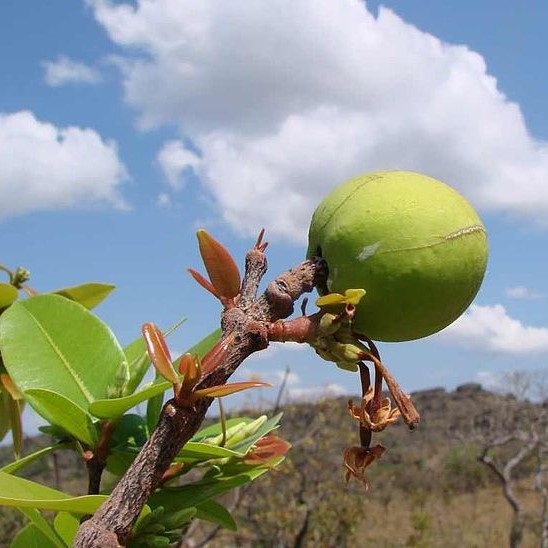
Native to the ‘Caatinga’, an extensive region of arid shrublands in Northeast Brazil and the nearby Coastal Forests, the Mangaba remains largely obscure beyond its indigenous habitat, a fact that belies its succulent fruits and remarkable adaptability to challenging environments. The ‘Caatinga’ is predominantly a desolate landscape, characterized by prolonged dry spells, tropical heat, and nutrient-deprived sandy and rocky soils. In response to the arid conditions, plants such as the Mangaba shed all their leaves during extended dry periods, only to regenerate with the onset of the rainy season. Like its fellow Caatinga native the Imbu, the Mangaba exhibits a resilience that allows it to thrive in savannah climates across tropical Australia. Mangaba require a full sun position. Still predominantly a wild and uncultivated species, Mangaba fruits are primarily harvested from wild plants, while cultivated specimens remain both rare and variable in form/fruiting. Plants will also grow along more coastal regions of Northeast Brazil. Originally cultivated for its latex, Mangaba fruits are best enjoyed fully ripe and softened to ensure no lingering latex or bitterness remains. When fully ripened, the fruits boast a delightful, unique flavour and aromatic pulp, ideal for crafting jellies, candies, preserves, juices, and even liqueurs. Additionally, the pulp freezes well, providing a convenient storage option as fruits can perish quickly. Mangaba matures to a yellow-orange hue, frequently adorned with red speckles or retaining a greenish tint. Fruits vary in size between 3-5cm, akin to between a Jujube or Plum. Mangaba trees assume an irregular and often crooked form, attaining maximum heights ranging from 5 to 8 metres, featuring a low crown. The new growth showcases an appealing Cherry Red color, while the fragrant white flowers add an ornamental touch to the tree. Well-adapted to the rigours of harsh, seasonal tropical climates, the Mangaba emerges as a delectable treat, even in the most unforgiving environments.
Where to Purchase – Online Nurseries (Australia Only)
Nursery
Mangaba – No known sellers, if you’re an online nursery selling this product get in contact!
Please reach out to us (Contact & Socials) if you come across any broken links, incorrect details, or if you represent an online nursery that sells the products mentioned above.


 Hortiforum