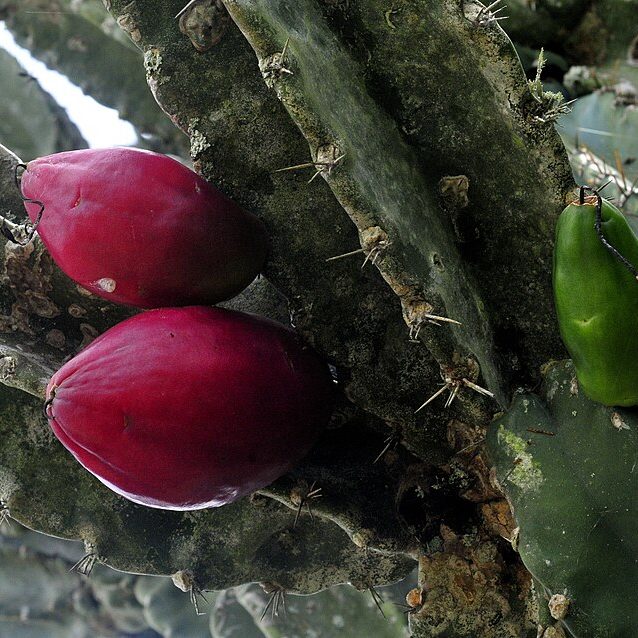
Mandacaru produces bright red, Pear-shaped cactus fruits that resemble those of its relative, the Apple Cactus (Cereus Repandus). Beneath the colourful, fleshy outer skin lies a succulent pulp that ranges in colour from white to deep violet-red. When fully ripe, the fruits often split open, exposing the flesh, making it easily accessible to birds and other wildlife in its native habitat, though this is less than optimal for gardeners wishing to savour the ripe fruits. Mandacaru fruit has a pleasant, mildly sweet flavour, often compared to a mix of Dragon Fruit, Banana, Strawberry, and Kiwifruit. Like many other cactus fruits, it contains numerous small, crunchy, edible black seeds. While most commonly eaten fresh as a refreshing snack, the fruit can also be preserved for later enjoyment. Mandacaru is native to Eastern and Central Brazil, particularly the tropical semi-arid savannah region of the Caatinga in the Northeast. This region is characterised by long, harsh dry seasons followed by short periods of intense rainfall. It is in these challenging conditions that the Mandacaru thrives, alongside other native edibles like the Imbu and Mangaba. The plant requires a position in full sun and well-draining soil, preferably with an acidic to slightly acidic pH. It thrives in tropical, frost-free climates. Outside of these conditions, Mandacaru has few requirements, especially regarding water. Naturally adapted to long dry spells, it is highly tolerant of semi-arid environments, making it an ideal low-maintenance option for such climates. Mandacaru is a distinctive, tree-like cactus that typically reaches heights of 7 to 9 metres at maturity. While its upright, columnar stems contribute to its striking form, the most notable feature is its large, white flowers, which bloom at night and may remain partially open during the early morning and late evening. The succulent stems are densely covered in sharp spines, making the plant unsuitable for placement near walkways or high-traffic areas. However, due to its dense, spiny growth and edible properties, it can be effectively used as a protective hedge, much like the Kei Apple or Natal Plum.
Where to Purchase – Online Nurseries (Australia Only)
Nursery
Mandacaru – No known sellers, if you’re an online nursery selling this product get in contact!
Please reach out to us (Contact & Socials) if you come across any broken links, incorrect details, or if you represent an online nursery that sells the products mentioned above.


 Hortiforum