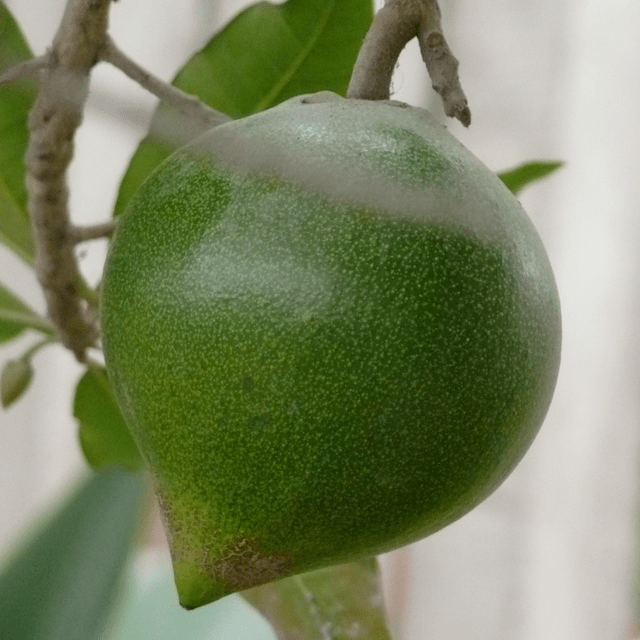
Native to the subtropical valleys of the Andes, the Lucuma is a distinctive fruit that boasts a round, green exterior and a vibrant yellow pulp, known for its sweet and mealy texture. A relatively unknown member of the Pouteria genus, the Lucuma shares numerous growing conditions with its close relative, the Canistel. Resembling the Canistel in size, the green-skinned Lucuma fruit features a peculiar pulp reminiscent of hardboiled egg yolk, yet it captivates the palate with a delightful sweetness. Its flavour profile is often likened to a wonderful blend of Sweet Potato, Butterscotch, Citrus, and Maple Syrup. Lucuma are broadly categorized as either wet, suitable for fresh eating, or dry, which are best combined with other ingredients. Highly esteemed in its native habitat, Lucuma finds versatile use in various forms—powdered, dried, or fresh—and serves as a delectable addition to ice cream, milkshakes, and puddings. Lucuma natively occur in the high-altitude montane forests of the tropical Andes from Peru to Ecuador. These subtropical highland climates experience consistently mild temperatures with warm days and cool to cold nights. Being native to these conditions, Lucuma exhibit impressive cold tolerance, surpassing that of the Canistel. During dormancy, Lucuma can endure temperatures as low as -5 degrees, albeit with severe damage to young growth which will occur at temperatures below freezing. Lucuma flourishes in subtropical climates, while also being highly viable in frost-free warm temperate climates with fruiting possible as far south as Adelaide. Lucuma, much like Green Sapote, stands out as one of the most well-suited Pouteria species for cooler climates. Growth may be stunted in hot, tropical regions and other Pouteria species such as Sapodilla and Mamey Sapote may be more viable. Similar to the Canistel, Lucuma prefers well-draining, fertile loam soil but displays adaptability to clay and sandy soils, with a moderate tolerance for dry and saline conditions. Optimal growth is achieved with moderate to high rainfall throughout the year, yet the plant exhibits partial adaptability to low rainfall and displays some drought tolerance. Under optimal, wild conditions, Lucuma trees can attain heights of up to 25m. However, in cultivation, they typically reach more manageable heights ranging between 8-10m, rendering them suitable for backyard cultivation. These trees develop a rounded crown, adorned with dark green, leathery-textured leaves, and produce yellow-greenish flowers. The perfect Pouteria for cool subtropical climates or for those in frost-free warm temperate regions seeking to explore this genus and relish its distinctive and delicious fruits.
Please reach out to us (Contact & Socials) if you come across any broken links, incorrect details, or if you represent an online nursery that sells the products mentioned above.

 Hortiforum