Frank Vincentz – CC BY-SA 3.0 – Wikimedia CommonsZeynel Cebeci – CC BY-SA 4.0 – Wikimedia Commons
General Info – Loquat, Japanese Plum, Japanese Medlar, Chinese Plum, Pipa
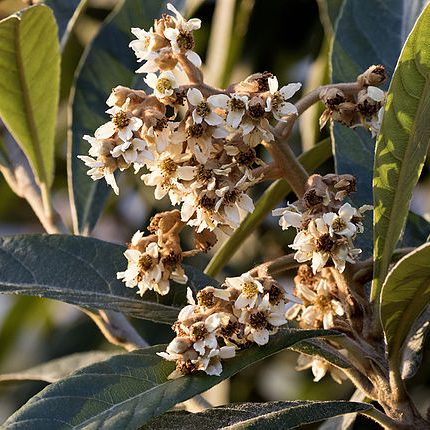
The Loquat is an excellent addition to any subtropical or temperate garden, known for its abundant crop of juicy, delicious fruit and its highly ornamental, shapely evergreen form. The juicy, orange fruit, highly regarded and commonly eaten in East Asia, where it has been cultivated for at least a thousand years. The soft, sweet flesh has a slight tang, with a taste reminiscent of Pears, Peaches, Apricots, and Citrus. These succulent, mouth watering fruits are commonly eaten fresh, with either the skin remaining or peeled. They are also perfect for baking into pies, transforming into sauces, blending into juices or preserving in jams. Gluts may also be canned or frozen for later usage. Loquat trees often produce two crops a year: one in late autumn and a second in early spring. Gardeners can thin sets of developing Loquats on panicles to three or four fruits, in order to encourage larger fruits. Netting may be required to protect the precious fruits from eager birds in particular. Due to their long-standing cultivation, many varieties have been developed and are available in Australia, all varying in size and form but remaining delicious. Nagasakiwase is a widely available and high-quality Japanese variety known for its large, sweet fruits with comparatively small seeds; hardy and capable of producing two crops a year. Bessell Brown produces massive, thick-skinned fruits that are resistant to bruising, unlike many other Loquat varieties. Champagne bears large, oval fruits late in the season with distinct yellow skin and white flesh that is wonderfully sub-acidic. Like Feijoas, Loquats are hardy in a wide range of subtropical and temperate conditions, tolerating temperatures down to -10 degrees Celsius when mature and dormant, although foliage may be damaged. Loquats can be grown as far south as Tasmania, provided they are in a maritime-influenced climate. They will grow and fruit prolifically in all Australian capital cities outside of Darwin. Loquat trees can tolerate a range of soil types, from sandy to heavy clay, and will thrive in a variety of loams, provided they are well-drained and not strongly alkaline. The preferred conditions are slightly acidic, well-draining but moisture-retentive loam soil in a full sun position. Loquat trees have good wind tolerance but are not suitable for the most exposed conditions with strong, buffeting winds. While moderate rainfall spread throughout the year is ideal, mature plants can tolerate moderate drought with sacrifice of smaller harvests, if drought occurs during flowering or fruiting. Loquat trees are highly ornamental, often being cultivated for this reason alone, providing a lush, evergreen shapely form to a temperate or subtropical garden. Specimens can reach heights of up to 10 metres, though dwarf rootstocks can keep plants below 2-3 metres and make them suitable for container cultivation. Loquats have attractive foliage with veined, lanceolate leaves that are glossy and dark green on top and furry underneath, making them a distinctive, evergreen attraction. Panicles of flowers often emerge attractively from terminal growth, similar to a Mango or Lychee, bearing up to ten white flowers that produce a sweet aroma. Historically, the loquat was thought to be part of the Mespilus genus (also in the Rosaceae family) and was known as the “Japanese Medlar,” named after the well-known Medlar, which was once a very popular fruit throughout Europe. Hardy, vigorous, and delicious, a Loquat tree is a valuable addition to any backyard.
All Varieties are Grafted unless noted. Please reach out to us (Contact & Socials) if you come across any broken links, incorrect details, or if you represent an online nursery that sells the products mentioned above.


 Hortiforum