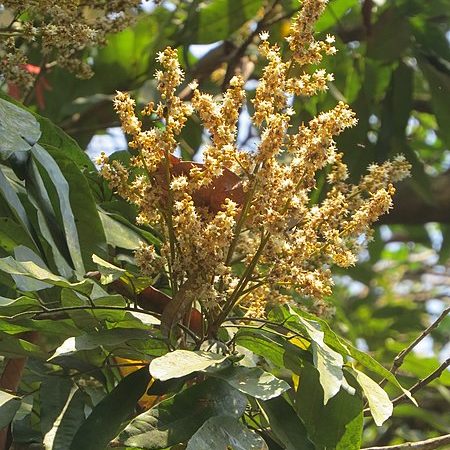
A close relative of the well-known Lychee, the Longan is an underrated alternative, thriving and vigorous in cooler climates, boasting a deliciously sweet, slightly tart fruit that closely resembles the Lychee. Although related to the Lychee, Longan fruits are noticeably distinct, being smaller in size, with a smoother brown-skin. Similar to Lychee, Longan boasts juicy and sweet translucent flesh, housing a sizable black seed. These features earned it the monikers ‘Dragon Eye’, the name by which it is known directly, or indirectly as the word Longan was developed from the Cantonese ‘lùhng-ngáahn’ which means ‘Dragon Eye’. Despite the shared flavour profile, the taste of Longan can vary among different varieties, often featuring a subtle muskiness that many find appealing. The Chompoo variety yields large fruits with a faint pink hue, while the popular Kohala matures early, offering a slightly spicy undertone. In contrast, the Haew variety ripens later in the season, presenting fruits with a smaller seed. Longan is a delectable treat enjoyed fresh, and its versatility extends to drying, canning in syrup, or even transforming it into a delightful wine. Longan trees natively grow in the humid mountainous woodlands of subtropical East Asia and are best cultivated in subtropical or (cooler) tropical climates. Longan will also tolerate frost-free, warm temperate climates and can withstand temperatures as low as -3 degrees when mature, making them well-suited for coastal temperate regions, reaching as far south as Melbourne. Longan plants prefer a slightly acidic, well-draining soil with consistent high rainfall throughout the year. However, a brief dry spell during dormancy enhances flowering. Excessively fertile soil may promote foliar growth at the expense of flowering, resulting in Longans thriving best in moderately fertile soils. Longan trees thrive when experiencing a distinct cool season leading to dormancy before flowering. In tropical areas with constant high temperatures, Longan trees may flower poorly and are better replaced by Rambutan or Pulasan. Commonly propagated through Marcotting or Air Layering, Longan trees can start producing fruit in 2-3 years. Nevertheless, plants propogated through Marcotting are fragile, particularly to wind, and should be strategically placed in a protected position. Cultivated extensively in China, the Longan is a medium-sized evergreen tree with an erect, handsome form and rounded crown that makes them an excellent focal point when allowed to flourish. This specimen tree typically attains a maximum height of around 10 metres but can be kept well below when pruned accordingly. The tree’s lush foliage is exceptionally ornamental, characterized by alternately arranged, pinnate leaves that exhibit a glossy surface and undulating edges. Flowering takes place as panicles emerge at terminal growth points, featuring small yellow flowers with a delightful scent. These blossoms eventually transform into clusters of fruits, which gracefully droop and ripen from late summer to autumn. A fantastic option for Lychee enthusiasts in temperate climates, the Longan is an underappreciated fruit that deserves a place in any garden.
All Varieties are Marcotted unless noted. (S) = Seedling. Please reach out to us (Contact & Socials) if you come across any broken links, incorrect details, or if you represent an online nursery that sells the products mentioned above.


 Hortiforum