General Info – Kaffir Lime, Makrut, Thai Lime, Asian Lime
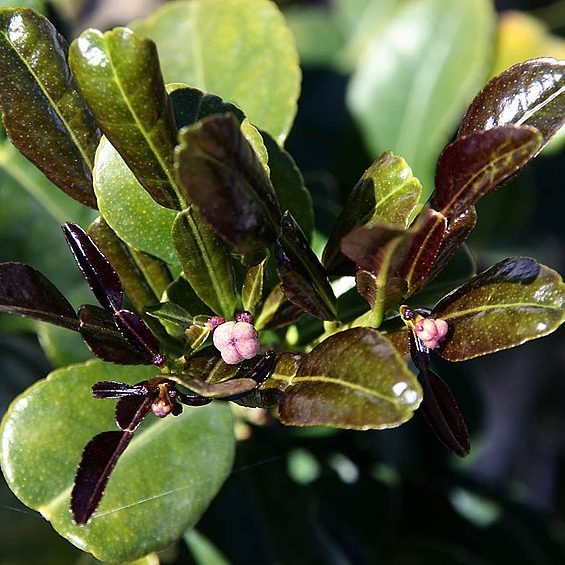
An original citrus species native to Tropical South-East Asia, the Kaffir Lime, or Makrut, stands out for its unique and unusual characteristics, both in appearance and culinary applications. Kaffir Lime has hourglass-shaped leaves exuding a strong Citronella fragrance and possessing a pungent Lime flavour. This citrus variety features rough, bumpy-skinned fruit that remains green when ripe. The lime-flavoured leaves play a crucial role in South-East Asian cuisine, enhancing the pungent flavors of soups and curries such as Thai Tom Yum and Indonesian Soto Ayam, while the fruit’s rind contributes to making a flavourful curry paste such as the Khmer Kroeung. For longer-term usage, the pungent leaves can be dried or frozen, while the rind can be dried and powdered. Despite the small size of the fruits and their production of only a negligible amount of sour, slightly bitter juice, the intensity of the flavour is striking. The Kaffir Lime makes for a perfect companion to the Calamansi (a Kumquat hybrid) for enthusiasts of South-East Asian cuisine, as the partially ripe form of Calamansi serves as an ideal sour condiment which the Kaffir Lime can struggle to fulfil effectively. Kaffir Lime plants are thorny, naturally adopting a shrub form that rarely exceeds 5 metres in height and often grows to 2-3 metres. The aforementioned hourglass leaves of the Kaffir Lime are its main ornamental feature, with new growth a glossy, purplish colour, and the white flowers bearing a delicate fragrance. Especially in their dwarf form, Kaffir Limes are well-suited for container cultivation due to their compact size and their leaves being the main product. Originating from the tropics of South East Asia, the Kaffir Lime is less cold-tolerant than other citrus varieties, even when on a cold-hardy rootstock, and may struggle with more than a moderate frost. To support healthy growth and robust fruit set, it is essential to provide these plants with abundant rainwater or regular watering. Avoid poorly drained soils, as Kaffir Lime plants thrive in deep, fertile, slightly acidic soil. Like all Citrus varieties, full sun is ideal for ensuring optimal health, form, and fruiting. However, partial shade is also acceptable, although it may lead to reduced fruiting, which would be undesirable for gardeners seeking to use the flavourful rind. The Trifoliata rootstock provides Kaffir Lime, as with all Citrus, greater tolerance to many conditions, including cooler weather and poorer soils. As a result, Kaffir Limes will tolerate occasional light frosts and can be cultivated easily as far south as Melbourne. The Kaffir Lime stands as a unique citrus option, particularly appealing to those with a fondness for South-East Asian cuisine.
All Varieties are grafted unless noted. Please reach out to us (Contact & Socials) if you come across any broken links, incorrect details, or if you represent an online nursery that sells the products mentioned above.


 Hortiforum