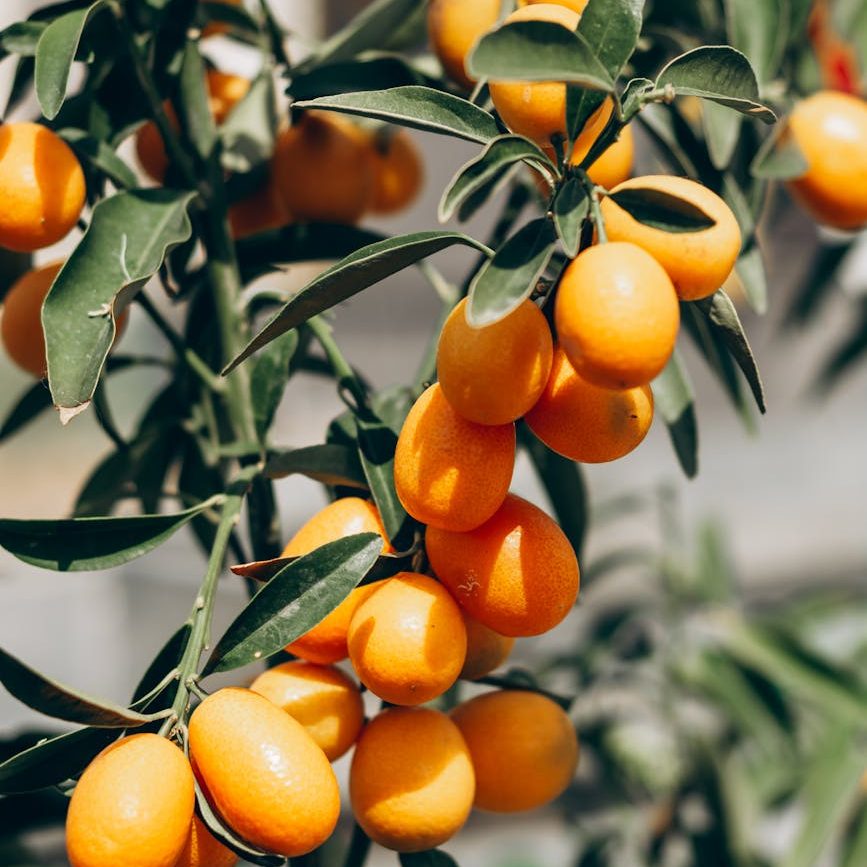
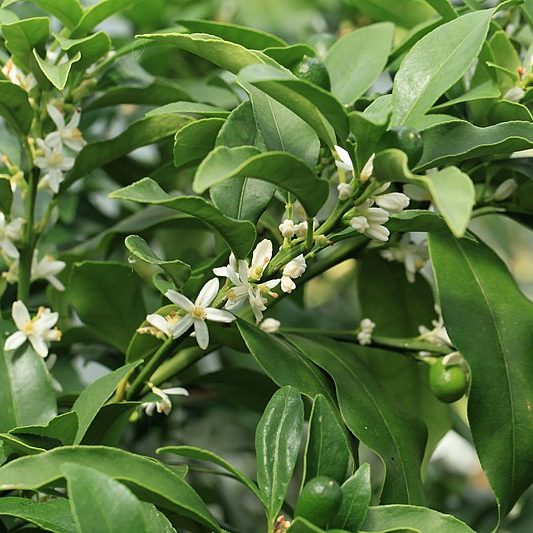
A prolific producer of small, orange fruits and one of the hardiest edible citrus varieties, the Kumquat is a resilient citrus that provides gardeners with an authentic East Asian / South East Asian fruit. Kumquats boast a delightful sweet and sour flavour, where the flavourful pulp’s tartness is balanced by the sweet, aromatic skin. Often transformed into scrumptious marmalades and preserves, Kumquats feature a sweet, fragrant peel when candied. There are multiple varieties available in Australia, such as the Meiwa with its sweet, relatively seedless pulp and the oval Nagami with its deeply aromatic skin. Calamondin’s are a Mandarin-Kumquat Hybrid popular throughout South East, with a particularly strong association and cultivation in the Philippines. If you’ve encountered what appear to be miniature limes served as condiments in South East Asian dishes, chances are they are partially ripe Calamondins. Calamondins can be made into a delicious juice when sweetened. Calamondin are extremely common throughout South East Asia and are well-suited to tropical, subtropical and warm temperate climates, but would be highly marginal in cool temperate climates which experience harsh frosts. Growing into a shapely, evergreen ornamental shrub below 5m tall, Kumquats can create a compact, edible hedge when appropriately pruned. Typical of all Citrus, the white flowers emit a beautiful, sweet fragrance that makes any garden a pleasure to be in. Ideal for container cultivation, Kumquats can be maintained as a manageable potted specimen while still yielding generous crops. Kumquat plants exhibit notable cold-hardiness, particularly during dormancy, reportedly tolerating brief temperatures as low as -8 degrees without harm. This exceptional cold tolerance makes Kumquats a viable choice for nearly all climates in Australia outside of the Alps. Thriving in slightly acidic loam soil with moderate year-round rainfall, Kumquats can adapt to diverse conditions, including heavy clay soils and drought, depending on the rootstock used. As with all Citrus, Kumquats should be provided with a full sun position. Highly ornamental and well-suited for environments beyond the normally, preferred Citrus climate range, the Kumquat is a space-conscious and versatile addition to any garden.
All Varieties are Grafted unless noted. Please reach out to us (Contact & Socials) if you come across any broken links, incorrect details, or if you represent an online nursery that sells the products mentioned above.

 Hortiforum