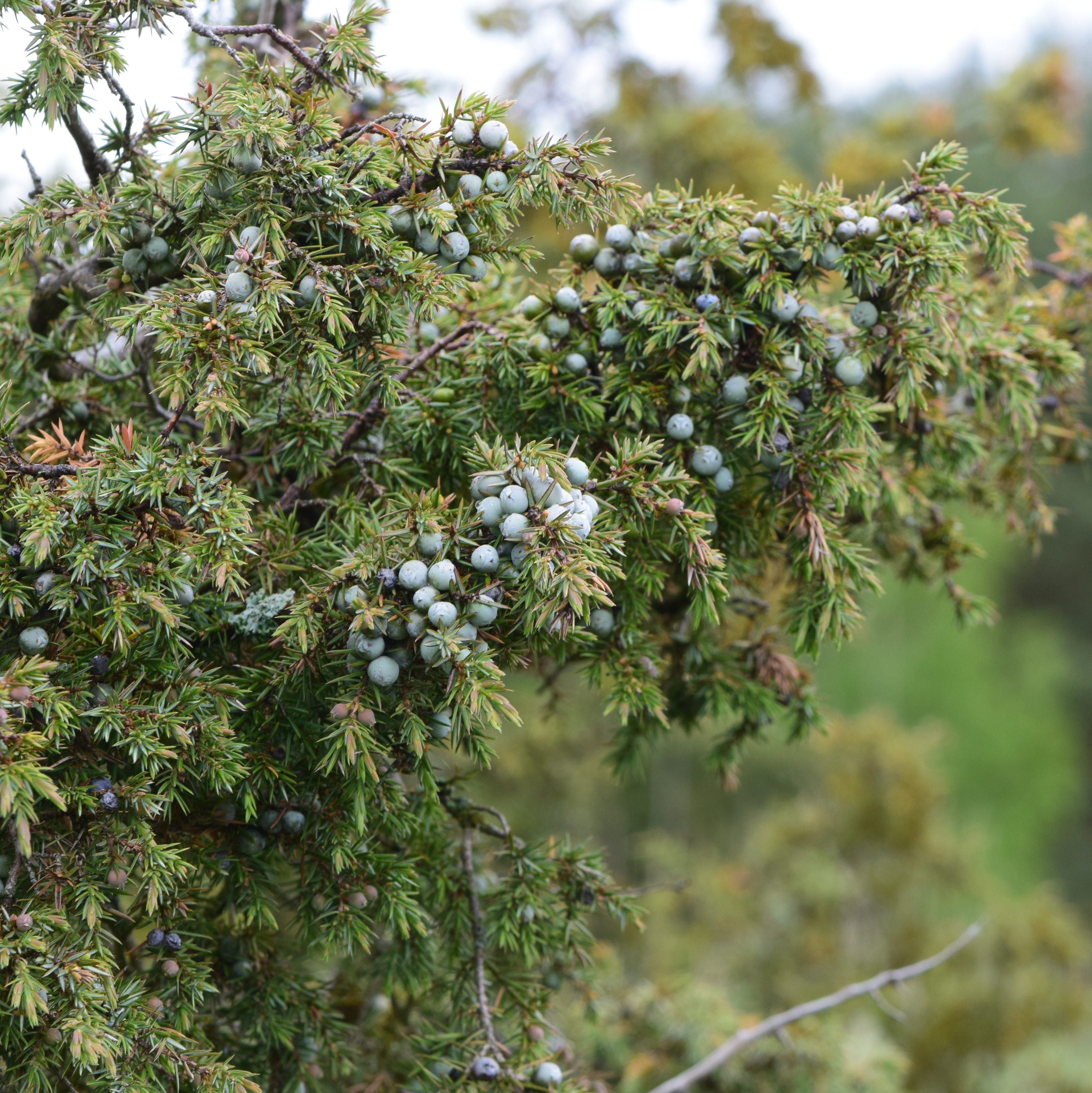
Krzysztof Ziarnek, Kenraiz – CC BY-SA 4.0 – Wikimedia CommonsKrzysztof Ziarnek, Kenraiz – CC BY-SA 4.0 – Wikimedia Commons
General Info – Juniper Berry, Common Juniper
The Juniper Berry, widely distributed throughout cool temperate regions in the Northern Hemisphere, stands as an exceptional hardy choice for any temperate garden. Juniper berries undergo a protracted ripening process spanning multiple years before attaining maturity, as evidenced by their transformation to a deep black hue once ripe. Juniper berries are too astringent to consume by themselves, but exude a highly aromatic fragrance and lend a delicate flavour to meats and sauces. Furthermore, they enjoy widespread usage across Northern Europe for infusing alcoholic beverages with their distinctive essence, particularly well known for their flavouring of Gin. Their usage is common across Northern Europe remaining common in traditional ales, ranging from the Finnish ale Sahti to the Dutch Jenever and the Slovak Borovicka. Belonging to the Cypress family, it boasts a distinctive ornamental appearance and diverse but gracefully-shaped growth habit. Juniper bushes display a remarkable array of forms, ranging from low-lying prostrate varieties found in alpine regions, scarcely rising above 0.5 metres off the ground, to erect shrubs or small trees that can be sculpted into iconic conical or teardrop shapes, or slightly more spreading forms reaching heights of up to 10 metres. Junipers boast dense, evergreen foliage of bluish-green needles that remain attractive throughout the year. Being dioecious, Junipers bear male and female cones on separate plants, necessitating the presence of both for cross-pollination and the production of juniper berries. Unlike most of their conifer relatives, the wind-pollinated cones remain fleshy during development, distinct from the hard cones typical of their relatives. Given the need to cultivate multiple Junipers for production, a hedge or windbreak comprising several plants is a productive and ornamental option Juniper Communis itself encompasses a wide range of subspecies adapted to varying climatic conditions, from alpine to temperate climates across Europe and North America. Generally however, Juniper Berries will endure extreme cold (especially by Australian standards), strong, buffeting winds, and moderate drought, thriving in exposed positions in mountainous regions. Junipers tolerate both full sun or partial shade, while preferring a well-draining soil but not demanding a specific soil type. For gardeners with the climate and curiosity, the cultivation of Juniper Berries presents few challenges and many opportunities to craft
Please reach out to us (Contact & Socials) if you come across any broken links, incorrect details, or if you represent an online nursery that sells the products mentioned above.


 Hortiforum