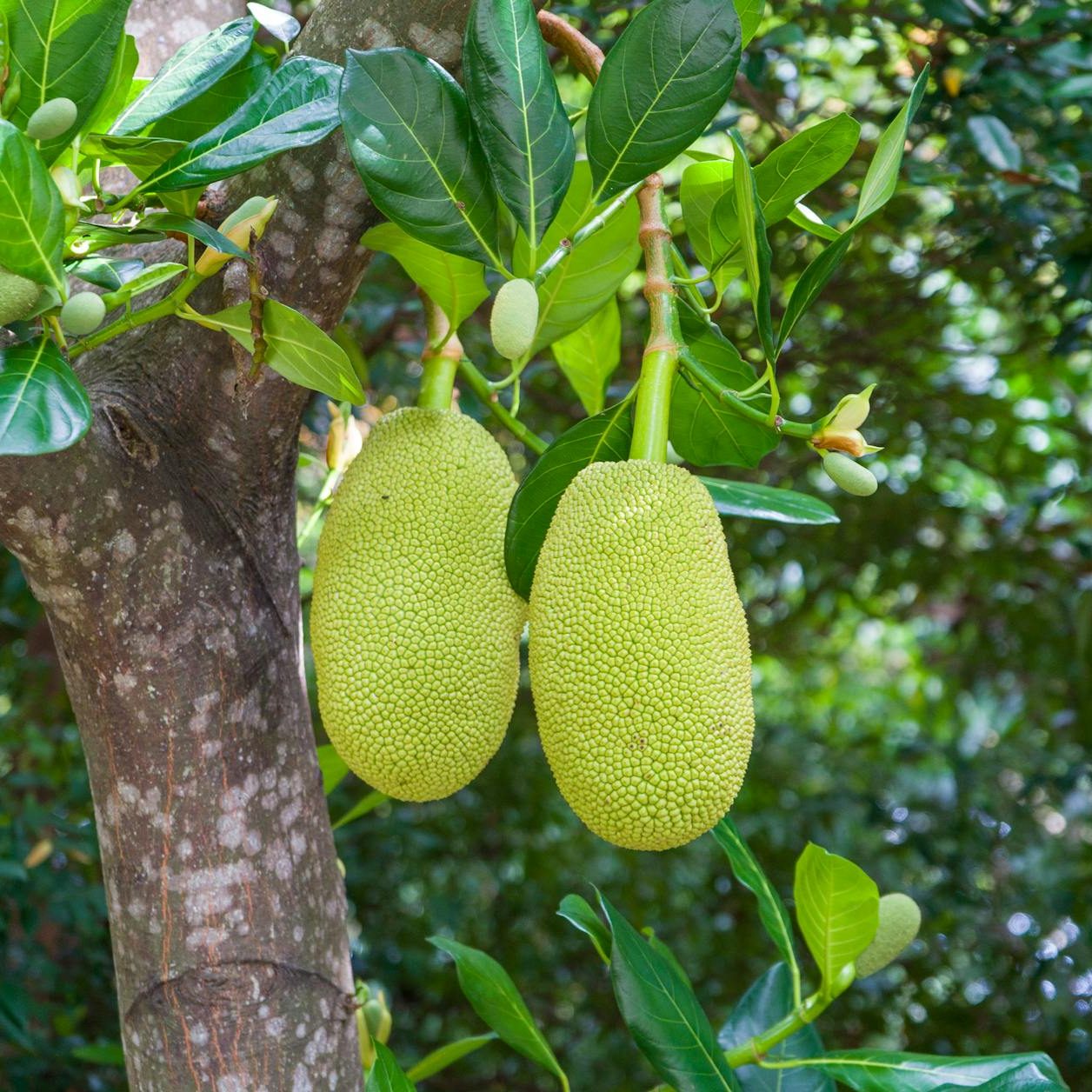
Jackfruit, an increasingly popular obsession for many, is widely cultivated throughout the tropics for its delicious and versatile fruits. Ripe Jackfruit offers a delightful tropical flavour reminiscent of Banana, Mango, and Pineapple, varying slightly among different varieties. The pungent, sweet edible arils of Jackfruit are one of the most exciting tropical experiences and are enjoyed fresh or dried in a variety of manners. Jackfruit is commonplace in many Southeast Asian desserts, such as the refreshing and sweet Indonesian Es Teler or Es Campur, and the Filipino favourite, Halo Halo. Its versatility extends to a range of desserts, including ice creams, puddings, and fruit salads. Additionally, Jackfruit can is superb added to smoothies, transformed into preserves, or canned for future use. The carbohydrate rich unripe arils can serve as a meat substitute in curries (such as the Indonesian Gudeg) and soups due to their texture and ability to absorb flavours. The protein-rich, starchy seeds can be enjoyed boiled or roasted and boast a flavour reminiscent of Chestnuts. To shield fruits from eager pests like possums, it may be necessary to bag them for protection. Jackfruit varieties are typically categorized as ‘Crisp’ or ‘Soft.’ ‘Crisp’ varieties are preferred for fresh consumption, while ‘Soft’ varieties excel in storage and preservation through drying or freezing. In Australia, there is a wide array of Jackfruit varieties currently on offer, each distinguished by its size, flavour, and colour. These range from the crisp, red-skinned Ratu Red, to the soft, Pomelo-sized Duranbah Gold, and the crisp, pale-yellow arils of the Rajhan, which offer a delightful hint of Vanilla. The large, glossy dark green leaves lend a distinctly tropical ambiance to any garden, making Jackfruit trees an attractive ornamental centerpiece. Fruiting occurs cauliflorously, with flowers and fruit forming directly on the main trunk and branches of the trees. This habit is likely crucial, given the substantial size of these compound fruits, with some reaching weights of up to 40kg. A rapidly growing tree with a dome-shaped canopy capable of reaching heights up to 30 metres under ideal conditions, though typically ranging between 10-20 metres, the Jackfruit is an outstanding choice for ornamental landscaping, serving as a focal point for both aesthetic enhancement and providing bountiful harvests. Jackfruit are cultivated across the tropics and frost free subtropics for the incredible productivity and versatility. While its cold tolerance is a topic of debate, exposure to temperatures below freezing are certainly preferable to avoid. With proper care during their early stages, Jackfruit trees can fruit in cooler subtropical climates, extending as far south as Sydney and Perth. Seedlings show the most viability in marginal climates, benefiting from a robust root system and greater adaptability. Jackfruit thrives in protected locations with consistent rainfall, warm year-round temperatures. Jackfruit thrives in slightly acidic to neutral, well-draining loam soils, and it’s crucial to keep the plants well-watered, as they exhibit minimal drought tolerance. While partial shade is appreciated during the seedling stage, mature jackfruit trees prefer full sun exposure. Remarkably, they begin fruiting within just three to four years. Jackfruit is more cold-tolerant than Breadfruit but less so than Kwai Muk, another member of the Artocarpus family suitable for cool subtropical climates. The Jackfruit serves as the ideal cornerstone for any tropical food forest, offering both productivity and versatility.
All Varieties are grafted unless noted. (S) = Seedling, (M) = Marcot, (U) = Unknown. Please reach out to us (Contact & Socials) if you come across any broken links, incorrect details, or if you represent an online nursery that sells the products mentioned above.

 Hortiforum