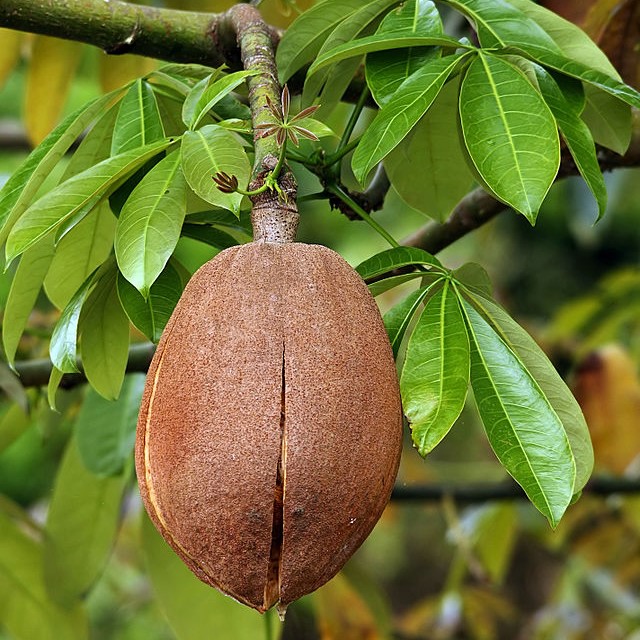
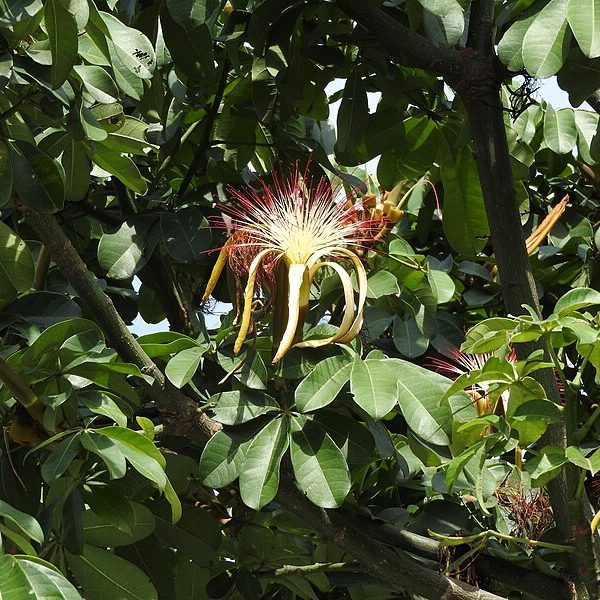
Hans Hillewaert – CC BY-SA 3.0 – Wikimedia CommonsYercaud-elango – CC BY-SA 4.0 – Wikimedia Commons
General Info – Guiana Chestnut, Saba Nut, French Peanut
Native to the Tropics of the Americas, the Malabar Chestnut is closely related to the Pachira Glabra, sharing many similarities with its botanical cousin. Highly ornamental, Malabar Chestnuts serve as an excellent centerpiece for any garden. The lance-shaped, glossy green leaves of the Malabar Chestnut are tightly grouped as compound leaves, exhibiting a vibrant dark red hue during new growth. The primary allure of the Malabar Chestnut lies in its flowers, among the largest globally. These blossoms boast gracious, elongated yellow petals and scarlet stamens, creating one of the most expansive and beautiful floral displays. In optimal conditions, this tree can reach a substantial height of up to 18 metres. For those with limited space, the closely related Saba Nut serves as an ideal alternative. Malabar Chestnut are a member of the Malvaceae family together with Kola Nut, Durian and Boab. Native to Tropical estuaries and freshwater swamps in the Americas, plants thrive in consistently moist environments and the Malabar Chestnut demonstrates exceptional tolerance to waterlogging and poor drainage. However, it exhibits limited tolerance to drought, necessitating frequent and ample watering. The Malabar Chestnut is sensitive to frost and thrives in environments with consistently warm temperatures throughout the year. Plants are suitable for warm, coastal temperate climates such as Sydney, where there is a specimen fruiting and flowering in the Botanic Gardens. Beyond its visual appeal, the Malabar Chestnut bears sizeable woody, brown pods up to 30cm in length. These pods split open at their base as they mature and are filled with seeds similar to the related Cacao. Up to 25 of these edible nuts can be found in the pods, with nuts having a pleasant taste reminiscent of Peanuts or European Chestnuts. These nuts can be consumed raw, roasted or ground into a flour, young leaves and flowers may also be used as a vegetable. Particularly advantageous for gardens susceptible to flooding, the Malabar Chestnut stands out as an excellent choice for individuals seeking a striking shade tree.
Please reach out to us (Contact & Socials) if you come across any broken links, incorrect details, or if you represent an online nursery that sells the products mentioned above.

 Hortiforum