General Info – Feijoa, Pineapple Guava, Guavasteen
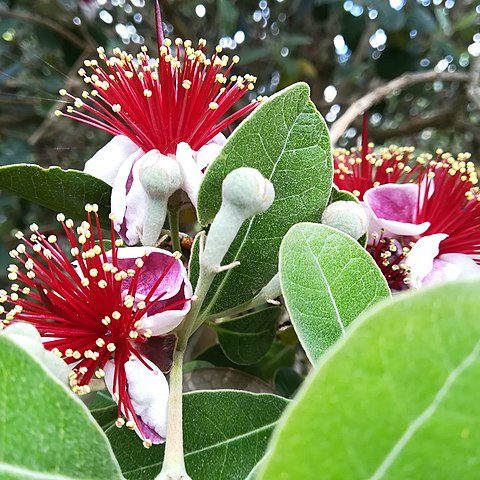
The Feijoa, or Pineapple Guava, stands as a highly underrated ornamental beauty, showcasing exceptional resilience to cold, robust winds, and drought conditions. The green, Kiwifruit-sized fruits reach maturity in autumn, gently dropping from the tree when ripe to be promptly, but easily collected. Fruits have a slightly gritty texture similar to that of a Pear, but offer an utterly delicious blend of Pineapple, Guava, Mint, and Sherbet flavors. Feijoas can be savoured fresh or chilled, either scooped out like a Kiwifruit or eaten whole, with the tart yet flavourful skin. The pulp of the Feijoa is reasonably firm akin to regular Guava, surrounding a luscious, gelatinous interior with edible, inconspicuous seeds that are easily propagated. Beyond fresh eating, Feijoas can be incorporated into fruit salads or transformed into excellent preserves like jams and jellies, providing a wonderful means to make the most of the bountiful harvests that often ripen in a short period. Feijoa are are a superb choice for gardeners seeking a low-maintenance addition to their garden. These versatile trees can be pruned to form hedges, small trees, or even espaliered, showcasing their adaptability to various garden designs. Feijoa trees naturally assume a handsome, rounded shape, reaching a modest height of 3-4 metres, adorned with an abundance of striking flowers during Spring. These striking flowers have prominent red stamens, contrasting beautifully against the pink & white petals, proving a beautiful sight in the garden. Flowers petals are additionally edible, imparting a delightful, floral taste reminiscent of Strawberries and are well suited to infuse and beautify beverages. The elliptical leaves display prominent grey veins with the upper surface of foliage boasting a dark-green, glossy sheen, while the undersides exhibit a silvery tone with a subtle wooliness, creating a beautiful and striking contrast and distinctive appearance, much like the Star Apple does but being suitable for temperate climates. The Feijoa’s exceptional cold hardiness for a subtropical evergreen is highly noteworthy, reportedly withstanding brief temperatures as low as -10 degrees when dormant in winter. However, it is highly advisable to shield young plants from subzero temperatures and plants are best planted in Spring. While they flourish in full sun, Feijoas tolerate partial shade, especially in their early years. Optimal flowering is achieved with a cooler period in the year, although extreme cold may harm flower buds. Pollination is a crucial consideration, with many varieties requiring another Feijoa for the process. However, self-pollinating varieties like Unique and Mammoth are available. Feijoa are moderately tolerant to drought and tolerant to strong winds. Given their capacity for withstanding strong winds and their dense growth pattern, consider planting multiple varieties to create an edible hedge that ripens across different months. In conclusion, the Feijoa, with its adaptability to diverse climates, captivating ornamental appearance, and delectable sweet/tart fruits, unquestionably merits a prominent place in any garden.
All Varieties are Grafted unless noted, (SP) = Self Pollinating. Please reach out to us (Contact & Socials) if you come across any broken links, incorrect details, or if you represent an online nursery that sells the products mentioned above.


 Hortiforum