
General Info – Curry Leaf, Curry Tree, Sweet Neem
An essential ingredient in Australian cooking, the fresh and pungent leaves of the Curry Leaf are a must-have for any lover of South Asian cuisines seeking to infuse homemade curries with an authentic flavour.
The aromatic foliage of the Curry Tree proves an indispensable component of South Asian cuisines, with the leaves boasting a pungent, earthy flavour likened to Citrus, Pepper and Anise. Leaves are at their most flavourful when fresh and can be added straight to Curries, similar to Bay Leaves. Additionally, they can be dry-roasted and ground into a powder. However, since only the foliage of the plants is utilized, there is typically a steady supply of fresh curry leaves throughout the year.
Plants produce inedible, small red berries containing poisonous seeds, which must not be consumed by humans. These berries are an attractive targets for birds and can readily seed in the wild, potentially becoming an environmental weed in climates where they thrive. To prevent this, it’s recommended to remove the berries in regions where the plants may become invasive.
Thriving in tropical and subtropical climates, the Curry Leaf also grows well in mild, temperate regions, provided the frost-tender tree is shielded from more than the occasional, light frost. Once established, the trees exhibit moderate drought tolerance and can withstand both full sun and part shade, though protection from strong winds and salt exposure is advisable. Trees thrive in a well-drained but moist, slightly acidic soil that is rich in organic matter. Curry Trees are well-suited to container cultivation as plants can be kept to a compact size while still being a productive producer of the valued leaves. Container cultivation will also allow for the convenient relocation of plants to optimal positions and provides an effective means for protecting berries from birds with the use of netting. Growing in pots will help avoid a relatively persistent issue of suckering that can occur with plants.
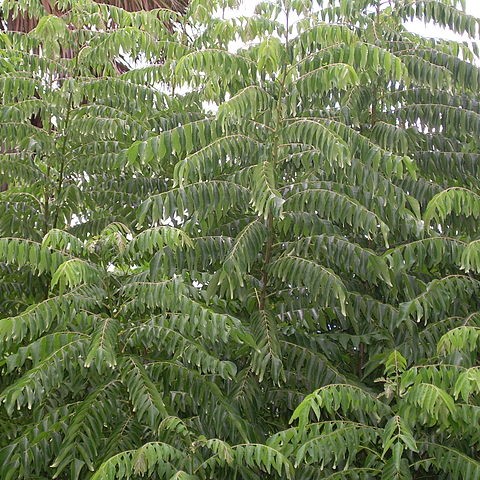
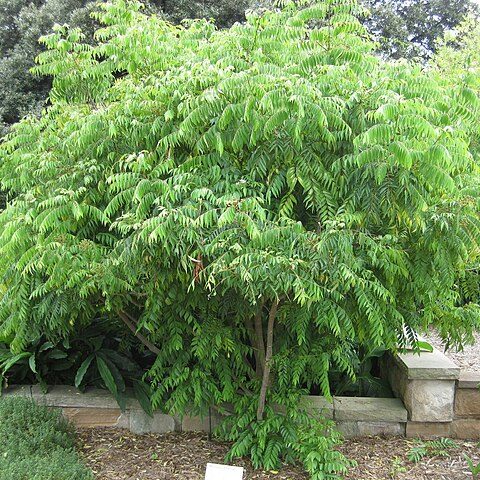
Plants make for a tidy tree with a spreading, rounded form, reaching up to 5m in height but can be easily kept much lower. The valued, pinnate foliage is borne oppositely and droops attractively. The clusters of fragrant, small, white flowers can be attractive but are best removed to prevent the development of berries.
Curry Trees form a neat specimen with a spreading, rounded form, reaching heights of up to 5m, but they can be easily maintained at a lower height. The pinnate foliage is arranged oppositely and gracefully droops. While the clusters of fragrant, small, white flowers can be visually appealing, it is advisable to remove them to prevent the formation of berries.
Fast-growing and yielding fragrant, flavourful leaves that enhance and invigorate any curry, the Curry Leaf enriches any garden and is a must-have for curry enthusiasts.
Plant Profile/Properties
| Preferred Climate(s) (info) | Tropical, Subtropical, Warm Temperate |
| Marginal Climate(s) | Arid |
| Cold Tolerance when Mature (info) | Low (-2) |
| Rainfall (info) | Medium |
| Pot Suitability | Yes |
| Sun/Shade Tolerance | Full Sun – Part Shade |
| Preferred Soil (info) | Good Drainage |
| Preferred PH (info) | Slightly Acid to Neutral (5.5-7.5) |
| Drought Tolerance | Medium |
| Wind Tolerance (info) | Low |
| Salt Tolerance (info) | Low |
| Pests & Diseases | Scale, Aphids, Mealy Bug |
 Hortiforum