
What does the number for ‘Cold Tolerance’ actually represent?
The term “Cold Tolerance” is unfortunately rather non-specific, referring to an approximate temperature at which plants have been observed not to suffer terminal or significant damage. Numerous variables come into play when considering cold tolerance, regarding both the hardiness of a plant (such as the specific variety, grafted rootstock, variable seedling hardiness, plant nutrition, and watering, as well as plant maturity) and the overall microclimate in which a plant exists (including factors like wind exposure, potentially warm surroundings like walls, and undercanopy shade). These variables contribute to diverse experiences for gardeners that may not always align to listed experiences.
The impact of cold weather is not easily categorized on a simple, binary scale of being either tolerable or fatally damaging. Instead, a cold tolerance figure may belie other effects of cold exposure, such as:
- Recoverable Plant Damage (ranging from significant to minor).
- Stunted, slow plant growth.
- Substandard to non-existent flowering and fruiting (often due to tropical plants being ill-suited to seasonal temperature variations in temperate climates).
- Poor quality of fruit/produce in terms of flavour, sweetness, and size.
The above impacts of cold exposure can occur simultaneously or in isolation. In many cases, gardeners may have to accept these are realities of cultivating fruit trees in marginal climates (Poorer fruit quality is a consistent and often unavoidable reality, but worthy sacrifice).
When discussing cold tolerance, it is crucial to consider the origin of information. While Australia often serves as the second most important source of english information for certain plants, the primary source is the USA, particularly the state of Florida. However, relying solely on Florida’s climatic experiences, especially regarding cold tolerance, may mislead Australian gardeners. Comparative examples reveal that Florida encounters more severe cold extremes (followed by warm temperatures) than cities in Australia located at comparatively more temperate latitudes.
| City (Latitude) | Miami (25°N) | Orlando (30°N) | Newcastle (32°S) | Melbourne (37°S) |
|---|---|---|---|---|
| Mean Daily Maximum – Coldest Month | 24.6 | 22.1 | 18.1 | 13.4 |
| Mean Daily Minimum – Coldest Month | 16.1 | 9.7 | 7.4 | 5.8 |
| Mean Minimum | 7.3 | 0.7 | 4.0 | 0.9 |
| Record Low | 0 | -4 | 1.0 | -2.5 |
As illustrated in the following examples, Orlando’s mean minimum temperature is relatively similar to that of Melbourne, despite Melbourne being at a notably more temperate latitude. As a result, an Orlando gardener may have experienced temperatures at 1 degrees and can report on the immediate impact of this upon a plant. However, this observation does not highlight the fact that, on average, Orlando’s peak winter months are significantly warmer, providing more favorable conditions for plants to recover and survive compared to Melbourne’s consistently cool temperatures.
When considering these above figures we should note that the mean minimum temperature is likely to be a brief, extreme period, which can be much better recovered from if warmer temperatures are experienced after. These brief extreme cold waves are characteristic of North America, whereas Australia, as an island, does not experience such extreme events (due to the moderating effect of the seas between itself and Antarctica where our most damaging cold fronts arise from). Mean minimum and record lows in Australia are less removed from the average winter experience. Meaning that temperatures are on average much closer to the mean minimum and reflect a generally cooler climate. Cold waves in Australia are often followed by comparatively cooler periods than gardeners in Florida would experience, reducing the ability for plants to rebound. The risk for gardeners is that they may identify the cold tolerance figure and note they don’t exceed it, but won’t be able to identify the importance of general winter conditions which may result in a slower death of a plant.
Consequently, gardeners in America can often focus on protecting their sensitive fruit trees from the minority of particularly severe cold nights. In contrast, gardeners in Australia must consider factors that provide consistent warmth and protection for sensitive plants throughout the year. As a result, while elaborate coverings may be especially useful in the American context, Australian gardeners will find it more important to ensure plants are placed in sheltered positions, protected from frost and wind, and supported with excellent nutrition and drainage.
What if my climate is too cold? What can I do to protect my plants from cold temperatures?
Gardeners have at their disposal a variety of measures, spanning from long-term strategies to short-term interventions, to safeguard their plants against cold temperatures. For enduring protection, creating a favorable microclimate that provides warmth, especially during the night, is crucial. Ideal placement involves sheltering cold-sensitive plants particularly from chilling winds, achievable through natural means like hedges or the strategic use of buildings. Opting for an understory position is also advantageous, as it tends to be slightly warmer at night, even though daytime temperatures may remain slightly cooler. Planting against warm, protective structures, such as a north-facing wall, is optimal for cold-sensitive plants, as these structures can retain and disperse heat overnight. Furthermore, akin to dealing with pests and diseases, robust and healthy plants exhibit greater resilience and tolerance under stressful conditions.
Ensuring both soils and plants remain well-hydrated during cold spells significantly enhances their capacity to retain heat and tolerate lower temperatures. Employing frost cloth or shade cloth to cover plants serves as a temporary yet effective solution against cold temperatures. Another method involves the use of lights (such as Christmas lights) to provide an additional 1-2 degrees of warmth, amplifiable with the simultaneous usage of frost/shade cloths. Christmas lights, rarely used during the Southern Hemisphere winter, are particularly convenient for households and can easily withstand outdoor weather.
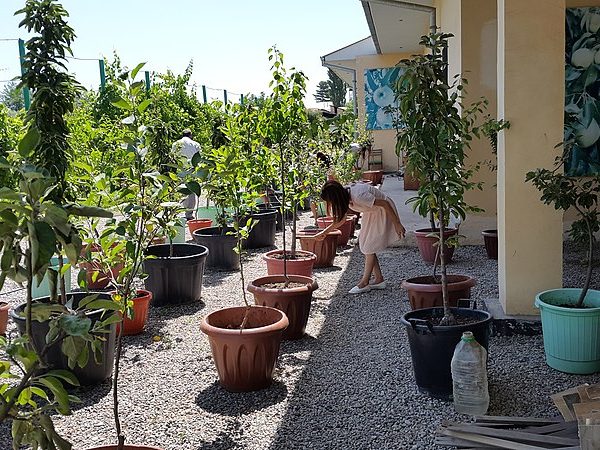
For a more practical approach, cultivating plants in containers such as pots or grow bags allows for easy transport indoors or to sheltered locations during the night. For those with the means, establishing a greenhouse or biodome offers a permanent and continuous solution, ensuring warmth throughout the warmer months by shielding plants from harsh elements.

Espaliered tree near Gaasbeek, Belgium. Pear and Apple trees are commonly espaliered against walls in Europe. This can be done in Australia with tropical fruit trees instead. Citrus such as Oranges & Lemons, and Passionfruit are particularly well-suited.

A Greenhouse in Sweden with Grapevine inside (and bursting outside). Smaller fruit tree such as Miracle Fruit, Blackberry Jam Fruit and Dwarf Jaboticabas could be perfectly suited to winter life in a greenhouse.
Shuhrataxmedov – CC BY-SA 3.0 – Wikimedia Commons
Array of Fruit Trees in Pots in Tashkent, Uzbekistan. These can be easily moved into sheltered locations as needed.
Potentially Helpful Videos
What are some cold hardy varieties for more tropical plants?
For numerous gardeners, cold spells and low temperatures represent an inevitable, unavoidable challenge, despite implementing measures to create a more favorable environment for plants. In such circumstances, gardeners don’t have to forgo tropical flavours entirely; instead, they can explore cold-tolerant varieties of tropical fruits as listed below (refer to their respective pages for estimated cold tolerances):
- Cold Hardy Citrus – Mandarins (Particularly Japanese Satsumas), Kumquats, Lemon & Yuzu
- Cold Hardy Avocado Varieties – Bacon, Fuerte, Shephard & Hass
- Cold Hardy Passionfruit Varieties – Black Varieties such as Misty Gem, Nellie Kelly, Sweetheart and Toms Special or the Banana Passionfruit
- Cold Hardy Mangosteens – Madrono, Yellow Mangosteen
- Cold Hardy Annonas – Cherimoya, Atemoya
Numerous cold-tolerant alternatives exist for common tropical fruits. For instance, Babaco or Oak Leaved Papaya can be grown instead of Papaya, and Feijoa, Cherry Guavas and Chilean Guava can be grown instead of traditional Guavas. Please refer to the ‘Frost Hardy Tropicals‘ page for a list of tropical varieties that can withstand variably cool conditions.
 Hortiforum