General Info – Cherry of the Rio Grande, Black Cherry
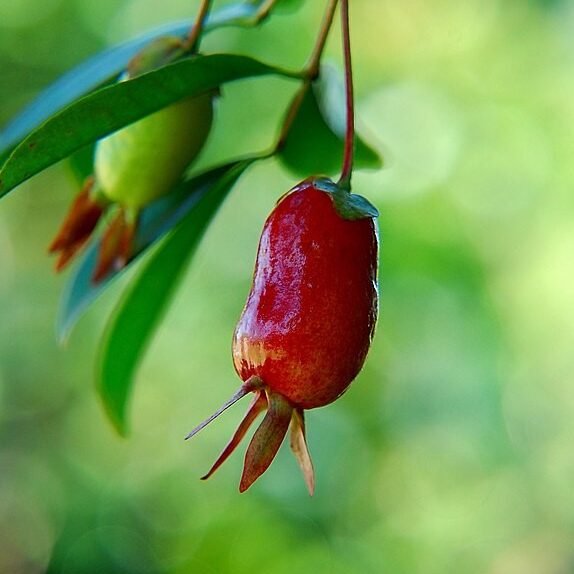
A rare Eugenia indigenous to the Rio Grande region of Brazil, the Cherry of the Rio Grande is a highly ornamental tree that yields delicious, sub-acid, cherry-like fruits. Requiring minimal maintenance, these trees naturally grow compactly with a well-defined shape, making them ideal for ornamental hedges where their wavy, glossy, elliptical leaves and stunning white flowers stand out. Typically reaching heights of 5-6 metres, this plant can grow substantially larger in optimal climates, forming a dense canopy. Its compact size renders it suitable for small backyards or container cultivation, also facilitating easy netting to provide protection against troublesome birds or fruit flies. Cherry of the Rio Grande thrives across a range of environments including savannas, grasslands, forests, and rocky areas, being not overly demanding in terms of soil fertility and quality, Trees thrive with year-round, moderate rainfall, especially during flowering and fruiting. However, they can tolerate moderate droughts, as commonly experienced in their native range. flourishing even in relatively unfertile soil. However, alkaline soils should be amended or avoided. Plants have reasonable drought tolerance, but for optimal productivity, it’s crucial to ensure ample rainfall or watering during blooming and fruit development. Given their shallow root systems and preference for consistent moisture, plants will greatly benefit from the application of mulch. Full sun or partial shade is suitable, and these plants can be cultivated in containers, offering the advantage of easy relocation to warmer spots during cooler months. Cold tolerance is notable for a eugenia, enduring temperatures down to -4 degrees when mature, although young plants lack frost tolerance and should be adequately protected. The medium-sized fruits have a globular to Pear-like shape as they mature, ripening quickly three weeks after flowering to a deep purple with a prominent calyx like other Eugenia. Fruits are juicy and possess a slightly acidic and sweet taste, akin to a cross between a Brazilian Cherry and a traditional Sweet Cherry. These fruits can be utilized in preserves, jams, or frozen for later use. Cherry of the Rio Grande is a superb alternative to the sweet cherry in tropical climates, much like the Cedar Bay Cherry is an excellent native replacement. Like other Eugenia trees, it is advisable to net the plants as their attractive, colorful fruit is often targeted by birds. Overall, the Cherry of the Rio Grande is a delicious snacking fruit boasting excellent form and appearance.
Please reach out to us (Contact & Socials) if you come across any broken links, incorrect details, or if you represent an online nursery that sells the products mentioned above.


 Hortiforum