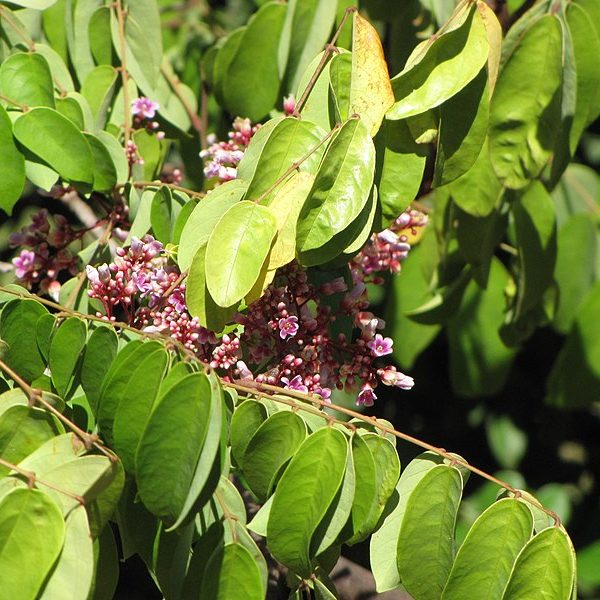
Commonly known as Starfruit due to its distinctive five-pointed, yellow fruits, the Carambola is an exceptionally ornamental tree that abundantly produces both fruits and flowers. When ripe, Carambola boasts a juicy, refreshing flesh with a delightful blend of sweet and slightly sour flavours. While these fruits are highly enjoyable when consumed fresh, they can also be used to make delicious juices and are excellent for preserves, thanks to their high pectin content. Gardeners have the pleasure of selecting from a variety of delicious cultivars, ranging from the Arkin, known for its abundant crops of firm yet exceptionally juicy and sweet flesh, to the medium-sized, relatively seedless Thai Knight, and the superbly flavorful Kary, which is more cold-tolerant than most varieties and produces multiple harvests each year. Carambola has a unique taste, often likened to a combination of Grape and Citrus. These trees thrive in frost-free climates but can tolerate light frosts once established and colder temperatures once mature. In marginal climates, trees may shed their winter leaves in spring, followed quickly by a flush of new leaves. However, this does not necessarily impede fruiting, provided there is a prolonged warm summer growing period. For optimal growth, Carambola prefers a position sheltered from winds and with fertile, slightly acidic soils. Regular, heavy watering, especially during the fruiting season, ensures the best results and yields juicy, high-quality fruit. Carambola trees are well-suited for pot cultivation, and grafted trees can begin fruiting at a young age. Resembling its lesser-known Averrhoa relative, the Bilimbi (popular throughout South East Asia), the Starfruit is aesthetically pleasing at every stage of its growth, featuring masses of pink and white flowers borne twice a year. Growing up to 12 metres tall, Carambola can be easily maintained at a smaller size without compromising fruit production. The pinnate leaves of Carambola grow symmetrically along branches, contributing to its pleasing appearance, especially when contrasted against the masses of pink and white flowers produced bi-annually. Aptly named Starfruit, the elongated, five-ribbed fruits form an iconic star shape when sliced and mature into a deep yellow, bordering on orange for some varieties. An iconic tropical fruit, Carambola not only provides flavourful and refreshing fruits but also adds an attractive evergreen element to its surroundings.
All Varieties are Grafted unless noted. Please reach out to us (Contact & Socials) if you come across any broken links, incorrect details, or if you represent an online nursery that sells the products mentioned above.


 Hortiforum