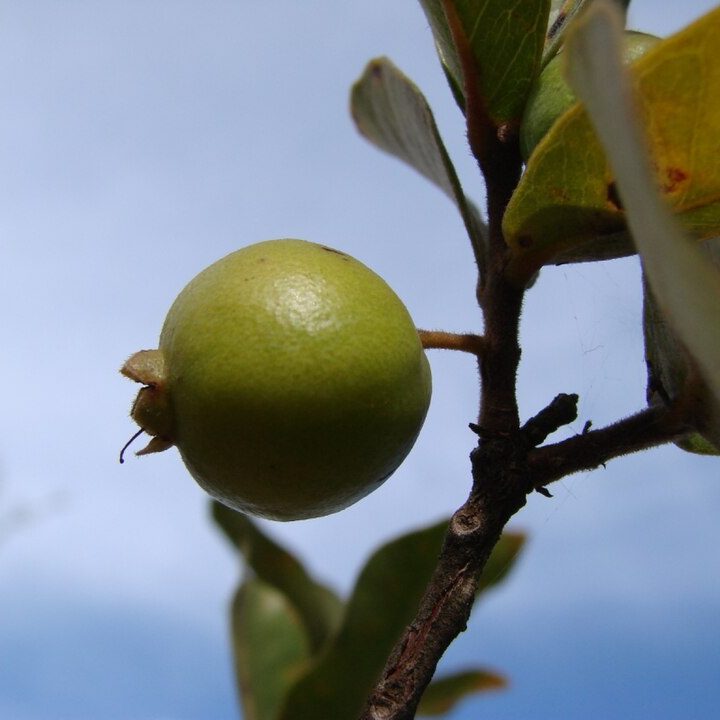
Note that the following photos are identified by their author as Psidium salutare var. pohlianum. Cambuitinga is variably regarded either as another variety of P. salutare (i.e., P. salutare var. decussatum) or as a distinct species, P. decussatum. In any case, the photos depict a closely related taxon; however, the fruits of Cambuitinga are notably white when ripe.
With its small, white, Strawberry Guava-like appearance, the Cambuitinga is an eye-catching, snack-sized fruit. It is best enjoyed fresh and can be eaten whole, savouring its sweet and succulent pulp. The fruit is also excellent for juicing; simply blend it and then sieve to remove the few seeds. The flavour of the juice is often compared to that of Atemoya. A small understory tree, rarely exceeding 2–3 metres in height even when fully mature. It has dense branching and a compact form. Other features are ornamental and closely resemble those of the related Strawberry Guava, including simple, hairless leaves arranged oppositely along the branches and a smooth trunk that peels to reveal a creamish-white layer beneath. The flowers are similarly attractive and ornamental, bearing a profusion of prominent white stamens typical of many members of the Myrtaceae family. As with many other members of the Myrtaceae family, the Cambuitinga is native to Brazil, though it is considered a rare species. It occurs in the eastern states of Brazil, including Minas Gerais, São Paulo, Bahia and Paraná, and has been reported in both littoral (coastal) and riparian (watercourse) forests. Unlike many Eugenia species, also part of the Myrtaceae family and native to Brazil’s Caatinga region where they are adapted to harsh savannah conditions, the Cambuitinga is less hardy, preferring areas with high rainfall, deep, moisture-retentive and slightly acidic soils. It grows well in full sun or partial shade, and although it can tolerate full shade, fruit production is likely to be reduced. The species is tolerant of light frosts and may be suitable for some warm temperate climates. Given its compact size and tolerance of shade, it makes an excellent gap filler or an understorey planting beneath a less productive canopy. It may also be successfully grown in pots or containers.
Plant Profile/Properties
Latin Name
Unclear (Psidium Decussatum or P. Salutare var Decussatum)
Please reach out to us (Contact & Socials) if you come across any broken links, incorrect details, or if you represent an online nursery that sells the products mentioned above.


 Hortiforum