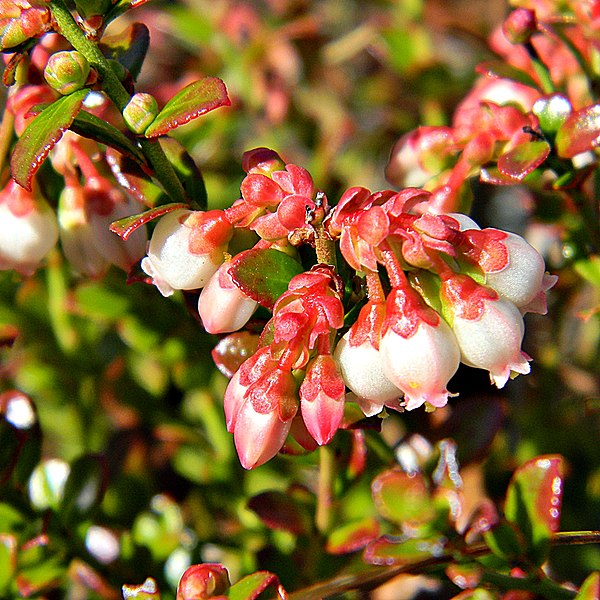
With their abundant crops of eye-catching berries, the Blueberry is a tasty, practical choice for many gardens owing to their compact nature. Fruit Nutrient and antioxidant rich, Blueberries are a delightful, healthy treat for the home-garden. Eaten fresh, frozen, dried or baked in pies and muffins, Blueberries have many delicious uses. Through planning and selection of multiple varieties, Gardeners can extend their blueberry harvest season to up to 6 months of the year. Growing Requirements Blueberries belong to the Ericaceae family, also known as the Heather family, which primarily consists of acid-loving plants. Other members of the Vaccinium family, such as Cranberries and Lingonberries, share this acidic preference. The key consideration in cultivating Blueberries is their need for acidic soils, with a pH between 4.5-5.5 being ideal. These pH requirements are not flexible and often necessitate soil amendment, such as through the application of powdered sulphur to acidify the soil. Meeting these pH requirements becomes more manageable through container gardening such as in pots or raised garden beds, allowing precise control over the growing medium. Using an acidic soil mix, readily available as a ‘Gardenia & Azalea’ mix, can promptly fulfill these requirements. Blueberries thrive in soil rich in organic matter that is both moisture-retentive and well-draining. As plants are vulnerable to both drought and root rot, it is critical that soil is well-draining. To maintain soil moisture for the sensitive surface roots, it’s advisable to provide a thick mulch, such as pine bark or pine needles, and ensure regular watering. As Blueberries are propagated from cuttings, they can bear fruit within the first year of purchase. The term ‘Blueberries’ commonly encompasses three different species: Northern Highbush, Southern Highbush, and Rabbiteye. These species vary in terms of chill hours, suitable climates, pollination requirements, and overall form as detailed below: Rabbit-eye Blueberry (Vaccinium virgatum): Native to the Southeastern United States, the Rabbiteye Blueberry is the most hardy, being partially tolerant to drought and adaptable to a range of climates. Rabbiteyes require cross-pollination unlike the partially self-pollinating Highbush. Northern Highbush Blueberry (Vaccinium corymbosum): The most commonly cultivated species and the most suitable for cool temperate climates. Northern Highbush are highly frost-tolerant but require over 700 chill hours. Plants go fully deciduous in the winter with beautiful fall foliage. Southern Highbush Blueberry (Vaccinium darrowii x corymbosum): A hybrid between Vaccinium darrowii which is native to the Southeastern United States and most commonly the Northern Highbush Blueberry (but sometimes the Rabbit-eye Blueberry). Southern Highbush are most suitable for subtropical climates with chill hours as low as 200 and tolerance for hot summer conditions. There are countless varieties of blueberries available for gardeners, including ‘Kisses’ with its large fruits and extended fruiting period of up to 6 months, the Rabbiteye ‘Rahi’ known for its flavourful light blue berries that store well, the early-fruiting ‘Biloxi’ that requires very few chill hours and produces firm-fleshed fruits, and the popular semi-dwarf ‘Sunshine Blue’ with its attractive pink flowers and delicious berries. Appearance Blueberry plants form a tidy shrub, generally keeping below 2-3m or even below 1m in semi-dwarf and dwarf varieties. Given their small size, Blueberries can be easily kept to a manageable size and when kept in pots can be easily moved around. Given this small size, the benefits of cross-pollination for fruiting and the ability to extend the season, growing more than one Blueberry plant is both practical and ideal. The attractive, white, bell-shaped flowers of the Blueberry are rather ornamental in spring.
All Varieties are grown from Cuttings unless noted. Please reach out to us (Contact & Socials) if you come across any broken links, incorrect details, or if you represent an online nursery that sells the products mentioned above.


 Hortiforum