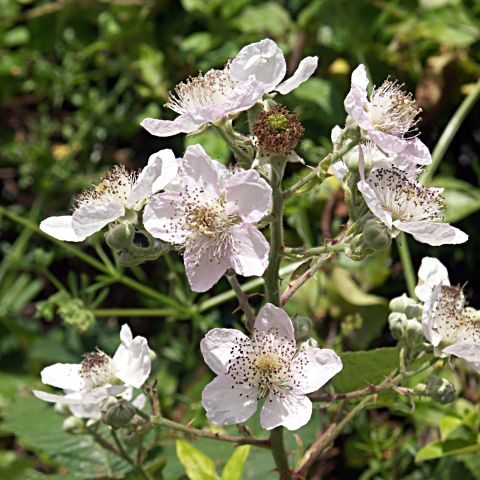
Juicy, large, and sweet, modern sterile cultivars of blackberries are not only delicious but also safe for home growers and the environment. Blackberries have been foraged for thousands of years, their abundant, juicy berries borne in abundance. Blackberries are a versatile ingredient, delicious enjoyed fresh, baked into pies, or transformed into jams, preserves, cordials, and liqueurs. Blackberry plants consist of long canes, reaching up to 7 metres with with curved, sharp prickles (although thornless varieties like Chester are widely available). Clusters of 3-5 leaves concentrate at the end of each stem, and white, five-petaled flowers emerge in Spring. Primocanes, the first-year canes, grow vigorously to their full length, while the second-year canes, called Floricanes, branch out laterally, producing flowers and fruit in traditional and wild varieties. Blackberry varieties traditionally fruit on their Floricanes, although newer varieties have been developed that fruit on their Primocanes (first year growth). Floricane varieties while requiring some maintenance of first year canes will produce Blackberries in Summer, while Primocanes fruit in Autumn. Due to their vigorous growth, it’s best to cultivate blackberries in contained spaces where the exploring suckers can be easily managed and restricted. Blackberries are native to Eurasia and thrive in the temperate climates of Australia, unfortunately becoming invasive in many areas. Blackberries are relatively undemanding, requiring only sufficient chill hours for the cultivar and well-draining soil in a sunny position, as they do not tolerate heavy shade or waterlogged soils. Moderately fertile soil and 700mm of rainfall are generally sufficient, making Blackberries low-maintenance and often requiring minimal soil amendment. Cultivated varieties commonly form erect canes that benefit from support, such as a trellis or wire. Blackberries, with their delightful sweetness and versatile culinary uses, now come in thornless or Primocane fruiting varieties in newly developed varieties, making this traditional and beloved fruit even more accessible.
Please reach out to us (Contact & Socials) if you come across any broken links, incorrect details, or if you represent an online nursery that sells the products mentioned above.


 Hortiforum