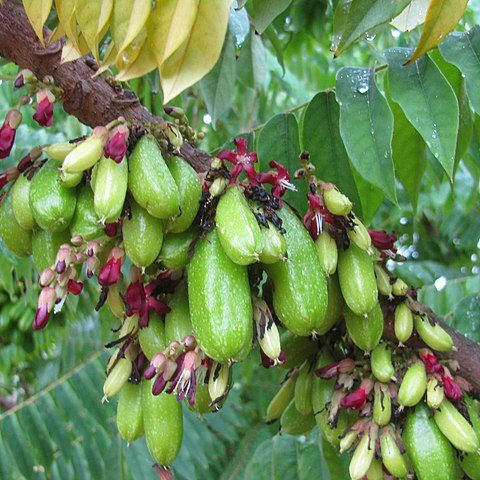
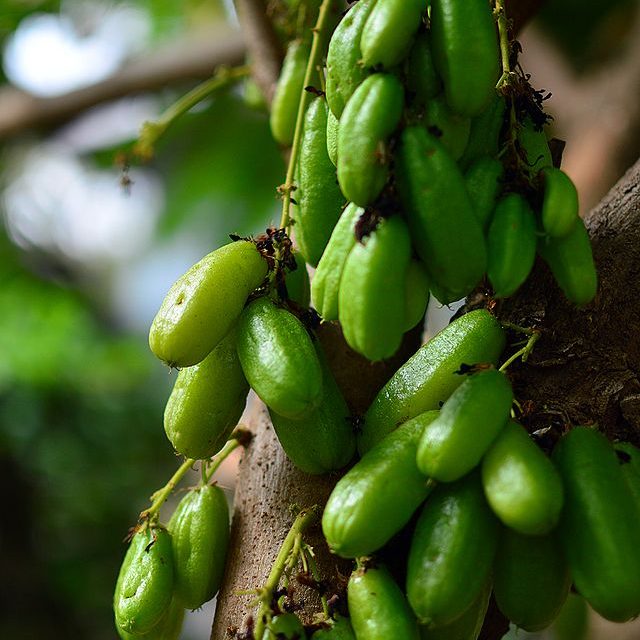
Native to the Spice Islands (the Moluccas) of Indonesia, the Bilimbi is a distinctive tropical tree known for its prolific production of small, cucumber-shaped fruits, earning it the moniker “Cucumber Tree.” These green, cylindrical fruits are highly valued in South East Asian and South Asian cuisines for their crunchy, juicy texture and intense, sharp acidic flavour. Resembling small cucumbers, the Bilimbi fruits measure at most 10cm, featuring glossy, pale green skin that matures to a light yellow hue. Exceptionally sour, even surpassing the acidity of Limes, Bilimbi’s mouth-puckeringly sour flavor is its defining characteristic. Similar to the Star Gooseberry, Bilimbi is seldom consumed on its own but rather processed or used as a sour accompaniment. When paired with salt and chili, the fruits become enjoyable and are commonly eaten this way. Bilimbi serves as an outstanding substitute for other sharp, acidic flavours, with its juice being utilised as a vinegar replacement or in lieu of sour Tamarind or Limes. Belonging to the Averrhoa genus alongside Carambola, Bilimbi shares a similar appearance in terms of both foliage and flowers, being an aesthetically pleasing addition to any location. Trees are covered in pinnate leaves arranged alternately along stems, drooping attractively for a distinct appearance. Fragrant, self-fertile flowers resemble those of the Carambola, emerging in clusters with dark purple, crimson blossoms. Cauliflorous like the Jaboticaba, Bilimbi trees bear fruit along the trunk and main branches, displaying abundant clusters of cucumber-like fruits. Bilimbi are more cold-sensitive than its Averrhoa relative the Carambola, struggling outside tropical climates and may be only marginal in subtropical regions. A full sun position in a well-draining soil is optimal with specific soil requirements being minimal although slightly acid, deep, fertile soils are preferred. A distinct dry season, lasting up to three months, is important for productivity and inducing flowering, which occurs during this dry period. In more marginal climates, protecting plants from strong winds is advisable. Widely cultivated across South East Asia for its sharply acidic fruits, Bilimbi is of exceptional culinary value and adds an enjoyable sight to any garden.
Please reach out to us (Contact & Socials) if you come across any broken links, incorrect details, or if you represent an online nursery that sells the products mentioned above.

 Hortiforum