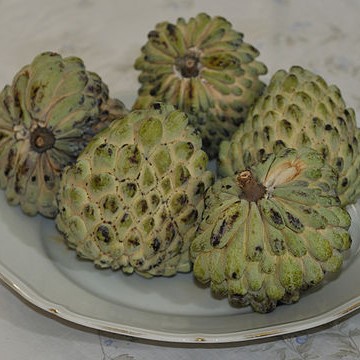
A cross between Cherimoya (Annona Cherimola) and Sugar Apple (Annona Squamosa), the Atemoya retains many features of both its parents, including the cold tolerance of the Cherimoya and the succulent, fruity flavour of the Sugar Apple. Atemoya trees produce heart-shaped green skinned fruits, similar in size to a Sugar Apple and with their distinct bumpy surface. As the fruits ripen, their skin softens and develops a brown tinge, starting on the protruding bumps. Atemoya has a good seed-to-flesh ratio with the toxic black seeds contrasting strarkly against the luscious white flesh. Atemoya are highly regarded for their sweet, creamy, custard-like pulp with a delightful tropical cocktail of flavours, likened to a Pina Colada (Coconut and Pineapple) with notes of Vanilla and a slight, pleasant acidity. Atemoya fruits are commonly eaten chilled or fresh on their own but are also used in beverages and desserts such as ice cream and smoothies. Atemoya fruits take between 4-6 months to ripen properly, often ripening in Autumn. This development often extends into the cooler months, which can be problematic in cooler, marginal temperate climates where the pulp can become somewhat insipid and bland. Atemoya is particularly well suited to subtropical and cool tropical climates, with temperatures between 20-30 degrees celsius ideal for pollination. Extreme heat will result in excessive growth but minimal fruiting and as such Atemoya are not ideal for ultratropical climates. Atemoya are widely cultivated throughout Taiwan, where they thrive in the consistent warm, humid conditions. Light frosts will be tolerate in addition to warm temperate climates that are largely frost free, such as Melbourne, although they may fruit poorly or of low quality due to the lengthy ripening time required extending into Spring. In marginal climates, gardeners can try cultivating seedling Atemoya for their greater vigour and adaptability. Provide Atemoya with a full sun position and protection from strong winds and any salt exposure. Atemoya plants are generally tolerant of a range of soils, including sandy, heavy clay, and alkaline soils, provided they are well-drained. The preferred soil type is slightly acidic, fertile loam, which can be developed through regular mulching, gypsum application, and compost. Regular watering during flowering and fruiting will maximise harvests, while droughts are tolerated but will significantly reduce fruit quality and harvest quantity. Atemoya plants develop an open, spreading canopy with drooping branches and a short trunk. If left unmanaged, they can reach a mature height of up to 10 metres, but with regular pruning, they can be maintained at a manageable height of 3 metres. Atemoya trees are partly deciduous and become dormant through late winter and early spring, dropping many of their leathery leaves. Atemoya produce unremarkable flowers, with three fleshy green petals. Flowering begins in Spring and can be encouraged through a short dry period, which leads to a focus on fruiting rather than growth. Atemoya trees are self-pollinating but often struggle to set fruit naturally, benefiting greatly from hand pollination. Some cultivars, such as Geffner and Paxton Prolific, will set fruit well naturally, without the need for hand-pollination. Well-suited to subtropical climates, Atemoya produce abundant harvests of creamy white pulp, ideal for fresh eating and a variety of desserts.
All Varieties are Grafted unless noted. Please reach out to us (Contact & Socials) if you come across any broken links, incorrect details, or if you represent an online nursery that sells the products mentioned above.

 Hortiforum