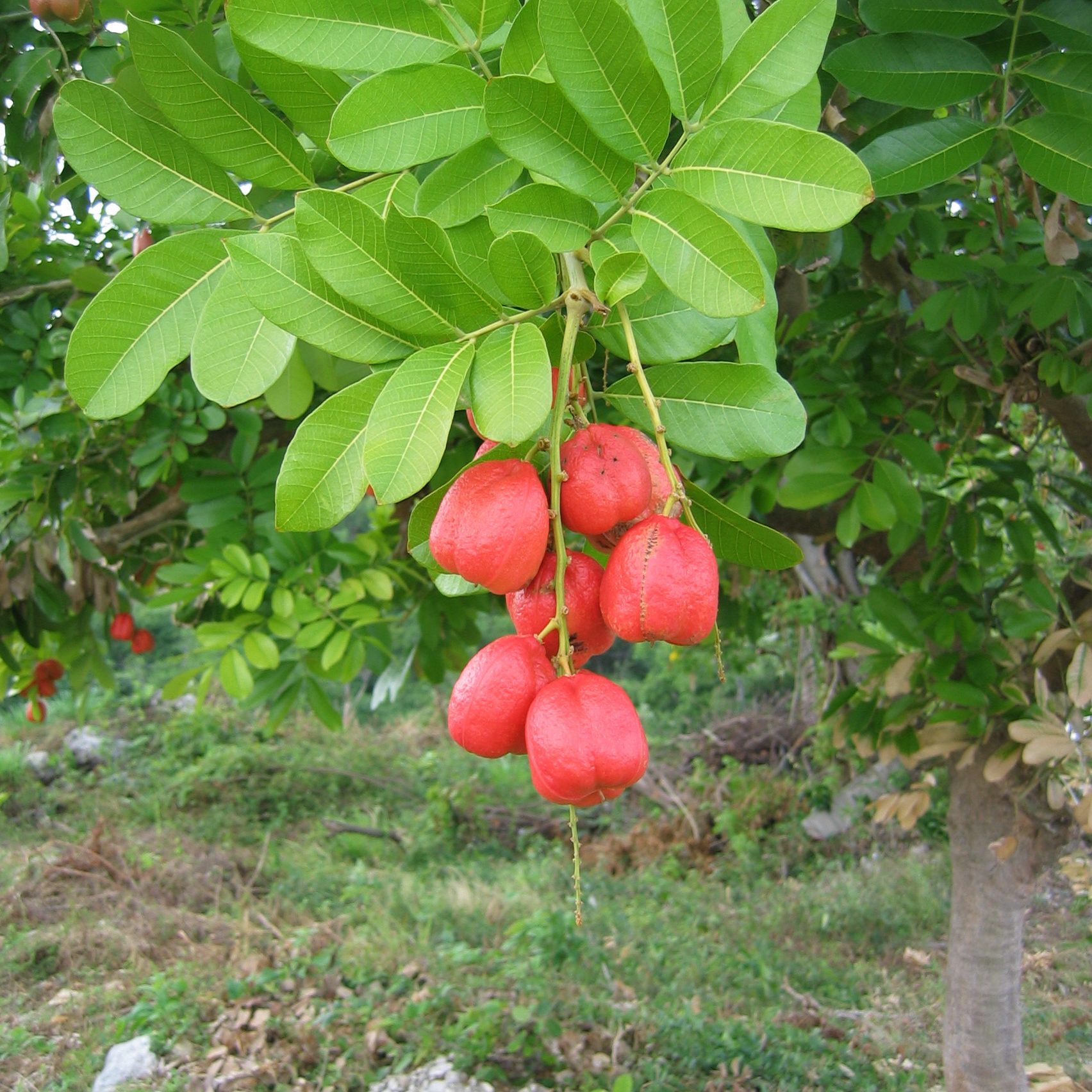
Note that the above fruits are unripe, having not split open. Jesper Rautell Balle – CC BY 3.0 – Wikimedia Commons
General Info – Ackee Apple, Achee, Akee, Ayee
The national fruit of Jamaica and a component of Jamaica’s national dish, Ackee and Saltfish, Ackee is widely consumed and grown throughout the Caribbean and its native tropical West Africa for its nutritious, tasty arils. Fruits can be divided into two varieties based on the type of arils, with there being a softer, yellow-fleshed variety and a firmer, cream coloured variety, with each having a nutty taste of Almond, Avocado and Egg. Ackee is traditionally consumed either parboiled or fried, where it can take on either a soft or firm texture while retaining a delicious taste. Only the ripe arils surrounding the seeds should be consumed. Ripeness is clear when the fruit splits open and reveals its seeds and arils. Take great care when preparing and consuming this fruit as only the ripe arils are safe to eat, all other parts of the fruit are poisonous, including the arils when unripe or overripe. Given this, it would be prudent to not place Ackee trees where the fruits may be accidentally consumed by children or unaware passersby. The Ackee is often planted for its ornamental purposes, owing to its fragrant inflorescences of small, greenish-white flowers. Plants grow up to 18m tall in optimal, tropical conditions and are quick to bear from seed, taking only 3-4 years. Fruits are borne in hanging clusters, with the thick, Pear-shaped, trilobed capsules ripening to a pale to bright red that contrasts attractively against the shiny foliage. Fruits can be borne year round in tropical climates, although the largest harvest is during Summer, especially so in subtropical climates. A member of the Sapindaceae family and relative of other tropical fruits such as Lychee, Rambutan and Mamoncillo, the Ackee has similar climatic preferences. Native to the tropics of West Africa, the Ackee has a preference for warm, moist tropical climates but can succeed in cooler frost free subtropical climates and will reportedly tolerate, very brief temperatures to -3 degrees once mature. Full sunlight, a slightly acidic, freely draining loam soil and moderate-high rainfall are optimal conditions. Protection from any salt or strong wind exposure is important. A truly unique fruit, providing an authentic taste of Jamaican Cuisine, the Ackee is a beautiful but dangerous fruit requiring careful consumption but when eaten ripe is a special experience.
Please reach out to us (Contact & Socials) if you come across any broken links, incorrect details, or if you represent an online nursery that sells the products mentioned above.

 Hortiforum